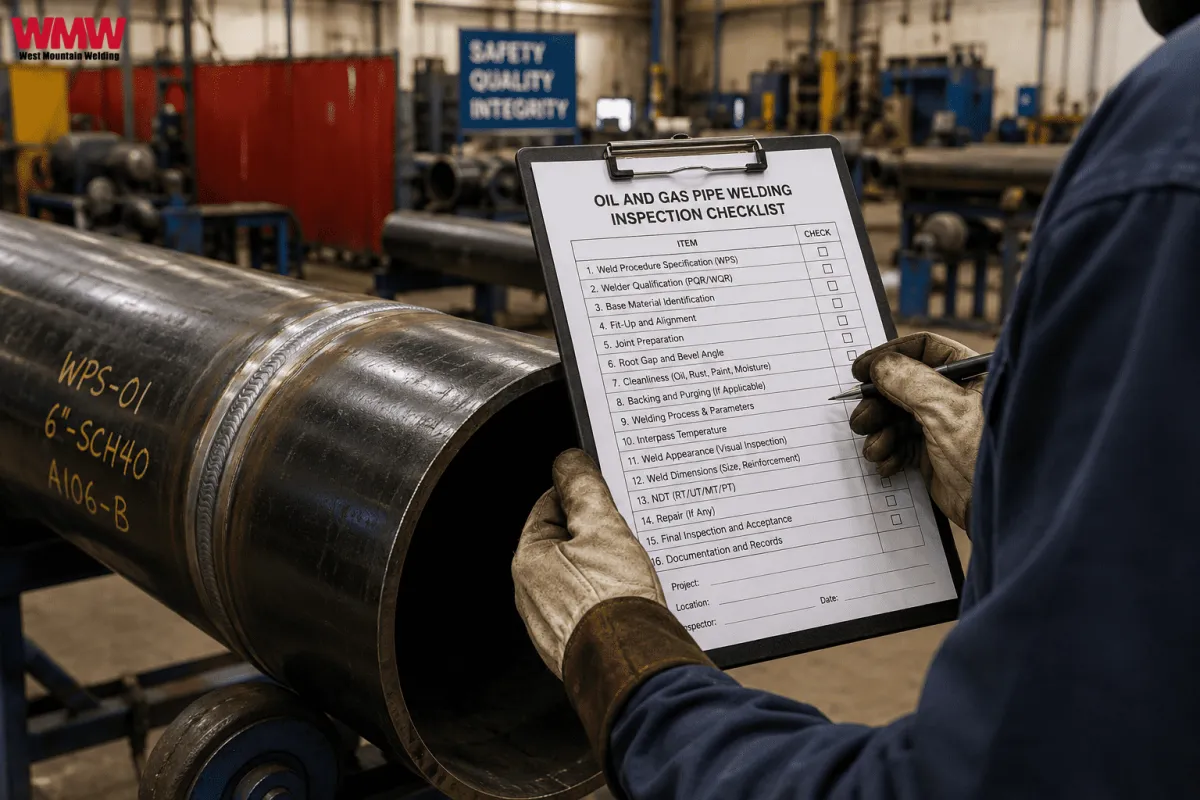
The Complete Oil and Gas Pipe Welding Inspection Checklist
A pipe welding inspection checklist is a structured set of pre-weld, in-process, and final inspection steps used to verify that every weld on an oil and gas pipeline meets code before the system enters service. It confirms welder qualifications, joint fit-up, heat control, and non-destructive testing results against standards like API 1104 and ASME B31.3, and it creates the documentation record operators need to pass a final audit.
Key Takeaways
A pipe welding inspection checklist covers three phases: pre-weld verification, in-process monitoring, and final inspection, and each phase catches a different category of defect.
API 1104 governs oil and gas pipeline welding, while ASME B31.3 applies to related process piping; both set the acceptance criteria an inspection checklist must reference.
Documentation is inspected as closely as the weld itself. Welder certifications, Welding Procedure Specifications (WPS), and material certs must clear review before an arc is struck.
Non-destructive examination (NDE) methods include visual, radiographic, ultrasonic, magnetic particle, and liquid penetrant testing to confirm weld integrity after visual inspection passes.
A pipe inspection checklist for oil and gas operators only works if it travels with the crew, no matter if that crew is welding in a controlled shop or responding to a field emergency.
Oil and gas projects do not leave room for guesswork. A missed fit-up tolerance or an unlogged interpass temperature can turn into a leak, a shutdown, or a failed audit long after the crew has moved to the next job. We build every oil and gas pipe welding inspection checklist around the 20-point structure below for shop and field crews across the Mountain West, so expectations stay consistent no matter who is on the joint or which site the work happens on.
Why Does a Pipe Welding Inspection Checklist Matter?
An oil and gas pipe welding inspection checklist exists because pipelines fail in predictable, preventable ways. A joint that is not fit up correctly, a pass that cools too fast, or a certification that expired without anyone catching it: each becomes a leak point, a shutdown, or a regulatory citation once the pipeline is buried or pressurized. A written checklist forces a structured sequence of checks so nothing gets skipped because a crew is behind schedule.
Two welders with identical training will still make different judgment calls under time pressure unless a documented standard removes the guesswork. A pipe inspection checklist for oil and gas operators puts pre-heat requirements, joint tolerances, and acceptance criteria in writing so the outcome does not depend on who happens to be on shift.
The Pipe Welding Inspection Checklist: 20 Points Across 3 Phases
Use this oil and gas pipe welding inspection checklist as a working reference on the shop floor or in the field. It is organized into the same three phases inspectors and pipeline engineers use on major projects: pre-weld, in-process, and final inspection.
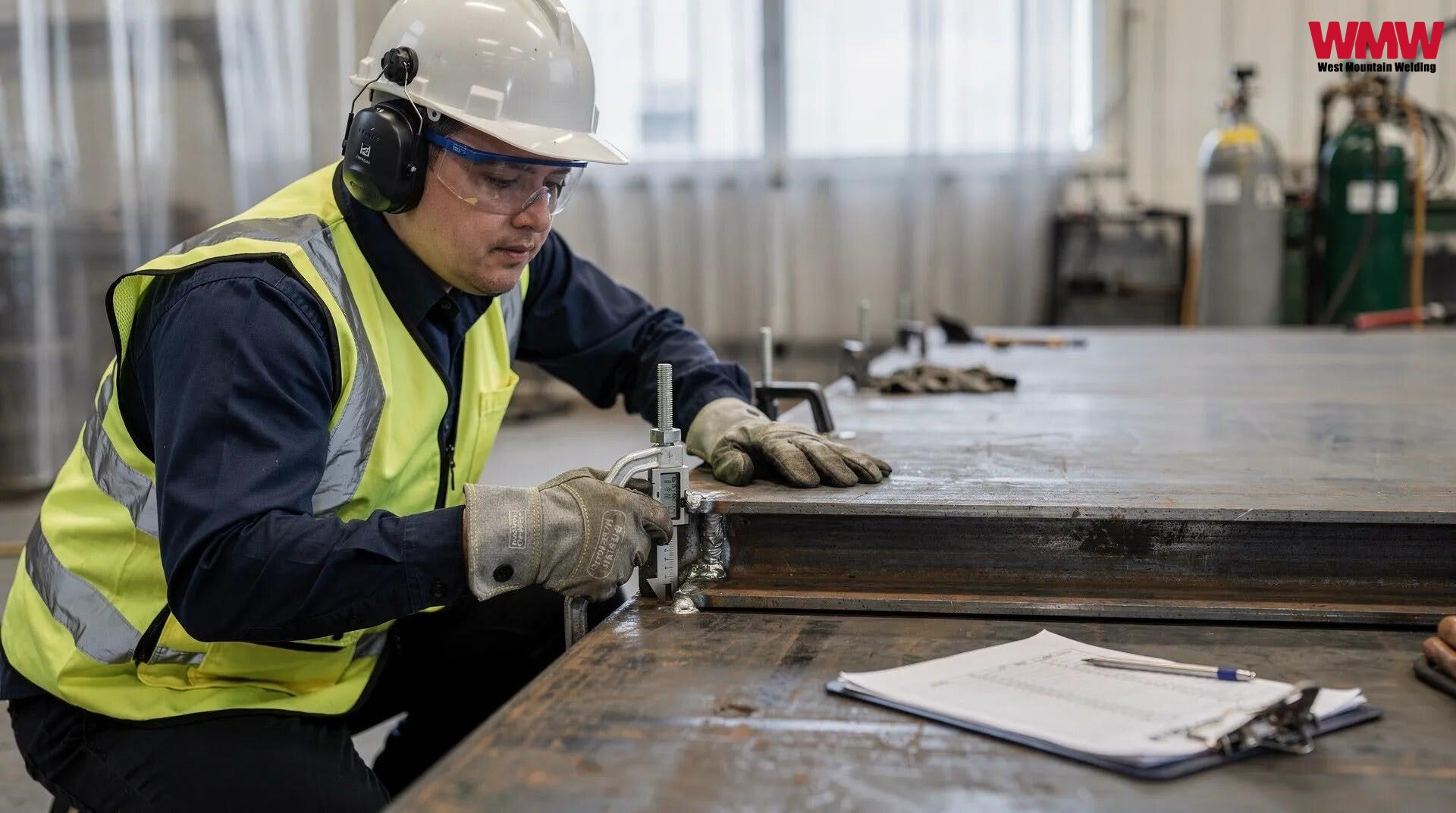
Phase 1: Pre-Weld Inspection Checklist (7 Points)
A pipe welding inspection checklist starts long before the first arc strikes pipe. Skipping this stage is expensive in a way that shows up later: fit-up errors, unqualified welders on the joint log, or a missing procedure approval all surface as rework, schedule slips, or a code violation on infrastructure that is difficult and costly to access once installed.
Verify welder qualifications. Confirm current certifications match the applicable standard ASME B31.1/B31.3, API 1104, or AWS D1.2, before any welder is assigned to the joint.
Confirm the Welding Procedure Specification (WPS). Check the WPS is reviewed and approved for the specific joint configuration, base material, and welding process.
Check material certifications. Match mill certs and heat numbers against the job package to confirm the correct grade and specification are on site.
Inspect joint fit-up. Verify bevel angle, root gap, and alignment fall within procedure tolerances before tack welding begins.
Examine base material condition. Look for laminations, surface defects, or damage that would not otherwise surface until after the joint is welded shut.
Confirm preheat compliance. Verify preheat temperature and method meet the WPS requirement for the material thickness and grade.
Check filler material storage. Confirm consumables are stored and handled under the specified conditions, with no exposure to moisture or contamination.
What Inspectors Verify Before Welding
Before welding begins, inspectors perform several essential checks to ensure the project meets quality and safety requirements. These include:
Documentation: Confirm that the Welding Procedure Specification (WPS), welder certifications, and material certifications are complete and up to date.
Joint Configuration: Inspect the fit-up, bevel angle, and root gap to verify the joint is prepared according to specifications.
Base Material: Check the surface condition, heat number, and material grade to ensure the correct material is being used and is free from contamination.
Equipment: Verify that preheat requirements have been met and that filler materials have been stored and handled properly to maintain their integrity.
We deliver prefabricated piping tagged directly to spool drawings, giving field inspectors an immediate cross-reference point and cutting down on fit-up errors before installation even begins.
Phase 2: In-Process Inspection Checklist (6 Points)
In-process inspection tracks weld quality while the joint is actively being welded. Catching a deviation at this stage stops a defect before it gets buried under the next pass, where it becomes far more expensive to find and repair.
Monitor heat input. Keep heat input within the procedure-qualified range to avoid metallurgical damage to the base material.
Track interpass temperature. Confirm the joint neither cools too fast nor retains excessive heat between passes.
Verify filler material in use. Confirm the correct consumable is being run for each pass, matching the WPS.
Check shielding gas integrity. Confirm atmospheric contamination stays excluded through the full weld cycle, especially on root and hot passes.
Review pass sequence. Confirm each pass follows the sequence specified in the WPS, with no skipped or reordered passes.
Log inspection results in real time. Record heat input, interpass temperature, and pass completion as welding progresses, not after the fact.
Shop fabrication under controlled conditions removes variables that field environments introduce by default, like wind, temperature swings, and inconsistent lighting. We apply controlled-environment quality control during shop fabrication, holding consistent weld quality across every spool before it reaches a job site. Not every weld happens in a shop, though.
We also deploy mobile field crews equipped for installation, repairs, shutdowns, and emergency response, bringing the same in-process oversight discipline to live oil and gas facilities.
Phase 3: Final Inspection and NDE Checklist (7 Points)
Final inspection combines visual examination with non-destructive examination (NDE) applied once welding is complete. Every weld has to clear defined pass or fail acceptance criteria tied directly to the applicable code before the pipeline system moves toward commissioning.
Perform visual inspection (VT). Check surface discontinuities, weld profile, and overall geometry as the first-pass final check.
Run radiographic testing (RT) where specified. Use X-ray or gamma-ray imaging to detect internal voids and inclusions.
Run ultrasonic testing (UT) where specified. Scan for subsurface flaws in thicker-wall pipe using sound-wave testing.
Run magnetic particle testing (MT) where specified. Check for surface and near-surface cracking on ferromagnetic materials.
Run liquid penetrant testing (PT) where specified. Use dye-based testing to detect surface cracks on non-ferromagnetic alloys.
Confirm dimensional tolerances. Verify final weld dimensions and pipe alignment meet the project drawings and code requirements.
Complete the documentation package. Record pass, fail, not applicable, or re-inspection status for every checklist item, tied to the specific acceptance criteria reference.
Each NDE method maps back to acceptance criteria set by the governing code. API 1104 for pipeline systems and ASME B31.3 for process piping are the two references that show up most often in oil and gas welding QA/QC programs. We execute oil and gas pipe welding to API 1104 and ASME B31.1/B31.3 standards, with procedures and qualifications available upon request.
Why Does an Oil and Gas Checklist Need Its Own Format?
A pipe inspection checklist built for oil and gas work has to align with the codes that actually govern that scope of work, primarily API 1104 and ASME B31.3. A checklist written for structural steel or general fabrication will not reference the right pressure-boundary acceptance criteria, and using the wrong reference standard is its own kind of compliance risk.
Pipeline welds carry pressure and often run through or near populated areas, which is part of why the acceptance criteria are tighter than what a general fabrication shop would use for structural steel. That code alignment is what keeps a project moving instead of stalling at inspection.
An oil and gas pipe welding inspection checklist built around the correct code from day one also makes life easier for third-party inspectors and regulatory reviewers, since they can trace every checklist item straight back to a specific clause instead of guessing which standard the crew was working from.
5 Common Mistakes a Pipe Welding Inspection Checklist Prevents
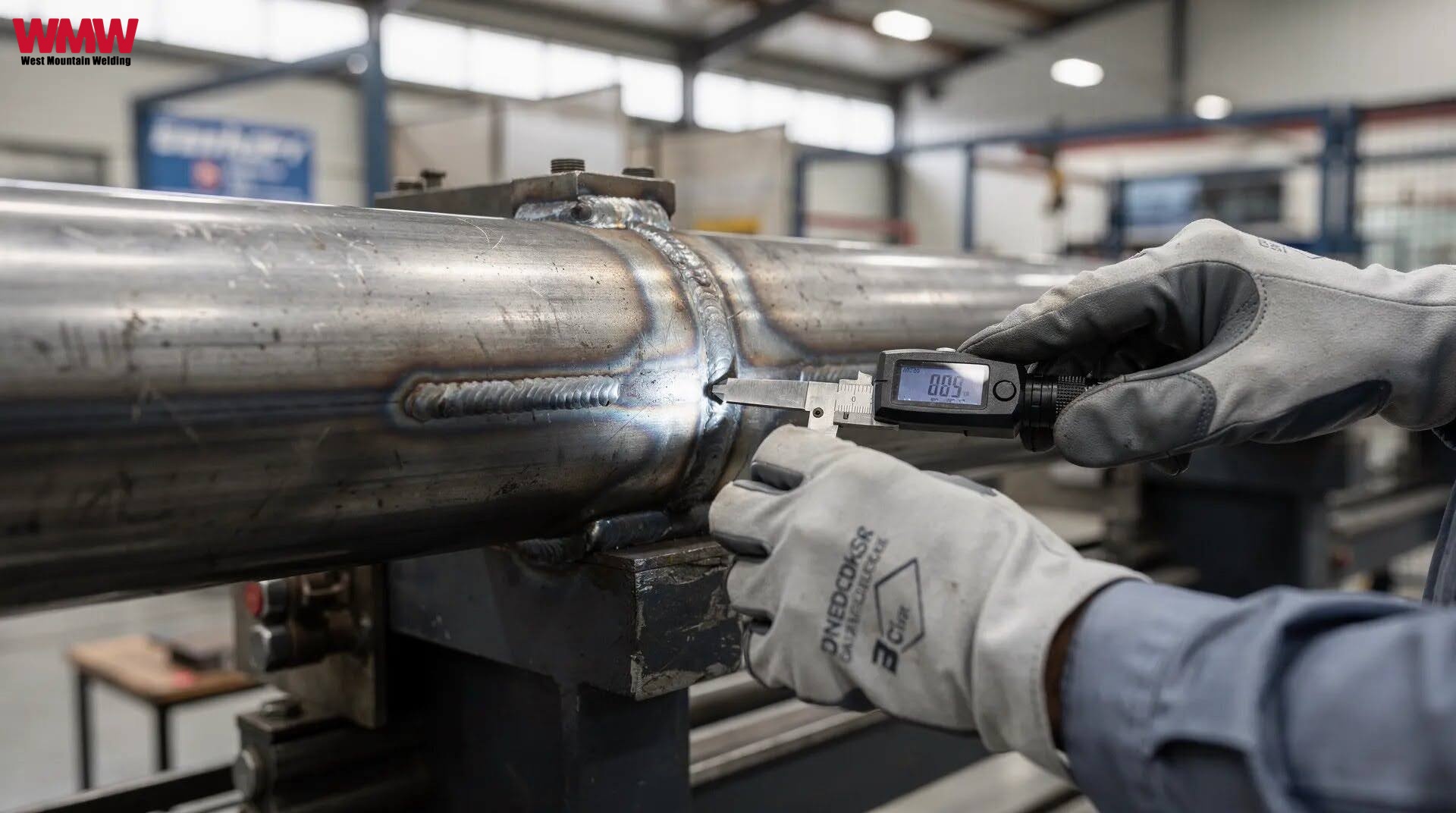
Most pipeline weld failures trace back to one of a handful of recurring mistakes. A structured checklist exists specifically to catch these before they become a field problem.
Welding before certifications are verified. A crew under schedule pressure sometimes assigns whoever is available instead of confirming the welder's certification still matches the current WPS and material.
Treating fit-up as a formality. Rushed root gap or bevel angle checks lead to incomplete fusion that visual inspection alone will not catch until NDE is run.
Letting interpass temperature drift. A crew focused on production speed can let a joint cool too fast between passes, which increases the risk of hydrogen cracking on certain pipe grades.
Skipping documentation until the end of the shift. Logging heat input and pass sequence after the fact instead of in real time leaves gaps that show up as missing records during a final audit.
Assuming a shop-fabricated spool needs less field verification. Even prefabricated, tagged piping should be checked against its drawing on arrival, since transport and handling can shift alignment before installation.
Building these five failure points directly into a pipe inspection checklist for oil and gas operators is what turns a checklist from a paperwork exercise into a genuine quality control tool.
How Does West Mountain Welding Support Your Inspection Process?
We support oil and gas operators across Utah and the broader Mountain West with field welding services built around code compliance and clean documentation. Operators working through a pipe welding inspection checklist get a partner who understands what an inspector looks for and delivers work built to pass on the first attempt.
The engagement process is straightforward:
Submit drawings and specifications for review.
Receive a clear, accurate quote with a defined timeline.
Schedule shop or field work aligned to project milestones.
That structure removes ambiguity early in the project. Fewer surprises during inspection means fewer delays once the pipeline is in the ground.
West Mountain Welding serves oil and gas production facilities across new builds, retrofits, and urgent repairs. An oil and gas pipe welding inspection checklist demands traceability, certified procedures, and qualified welders, all of which the company treats as standard practice, not as an upsell.
Prefabricated piping is tagged to drawings, with procedures and welder qualifications available upon request, and field crews mobilize across Utah and neighboring Mountain West states to keep a planned retrofit or an emergency repair alike on schedule.
FAQ
What three phases does an oil and gas pipe welding inspection checklist cover?
Pre-weld verification, in-process monitoring, and final inspection, with each phase catching a different class of defect.
Which code governs oil and gas pipe welding inspection requirements?
API 1104 governs oil and gas pipe welding inspection, covering welder qualifications, procedure specifications, fit-up, and NDE.
What happens when pre-weld checks are skipped?
Fit-up errors, unqualified welders, and missing documentation cause rework, schedule delays, and possible code violations.
What NDE methods confirm final weld quality on a pipeline?
Visual, radiographic, ultrasonic, magnetic particle, and liquid penetrant testing confirm weld integrity after visual inspection.
Does West Mountain Welding provide procedures and welder qualifications on request?
Yes, West Mountain Welding makes procedures and welder qualifications available on request for every oil and gas pipe welding project.