Common Oil and Gas Welding Pipe Problems & How to Avoid
Common oil and gas welding pipe problems include poor fit-up, unground cut edges, incorrect machine settings, and porosity, all of which produce weld defects that lead to leaks or line failure. Preventing these issues starts with proper alignment, edge prep, and certified welding procedures such as API 1104.
Key Takeaways
Poor fit-up and misalignment are the leading causes of pipe welding defects on oil and gas projects.
Nine recurring problems, from unground cut edges to incorrect amperage, account for most pipeline weld failures.
Pipeline welding inspection catches subsurface flaws like porosity and lack of fusion before a line goes into service.
Certified welders working to API 1104 and related codes reduce rework, leaks, and schedule delays.
Why Do Oil and Gas Pipeline Welds Fail?
A pipeline is only as strong as its weakest joint. In oil and gas welding, that joint has to hold under constant pressure, temperature swings, and years of service life, so there's no margin for a defect that looks minor on the day it's made.
Most pipeline weld failures trace back to two root causes: welding technique and machine setup. Fit-up that's slightly out of alignment, an edge that wasn't ground clean, or a wire feed speed that's off by a few inches per minute can all seem like small variances in the moment. Under pressure, in the field, they become leaks, unplanned shutdowns, and expensive re-welds.
Oil and gas pipeline welding also carries a compliance dimension that other welding disciplines don't always share. Codes like API 1104 and ASME B31.1/B31.3 exist because a single undocumented shortcut on a pressurized line can turn into a safety incident, an environmental release, or a facility shutdown. Understanding where welding defects in pipelines typically originate is the first step toward a project that passes inspection the first time instead of the third.
What Are the 9 Most Common Oil and Gas Welding Pipe Problems?
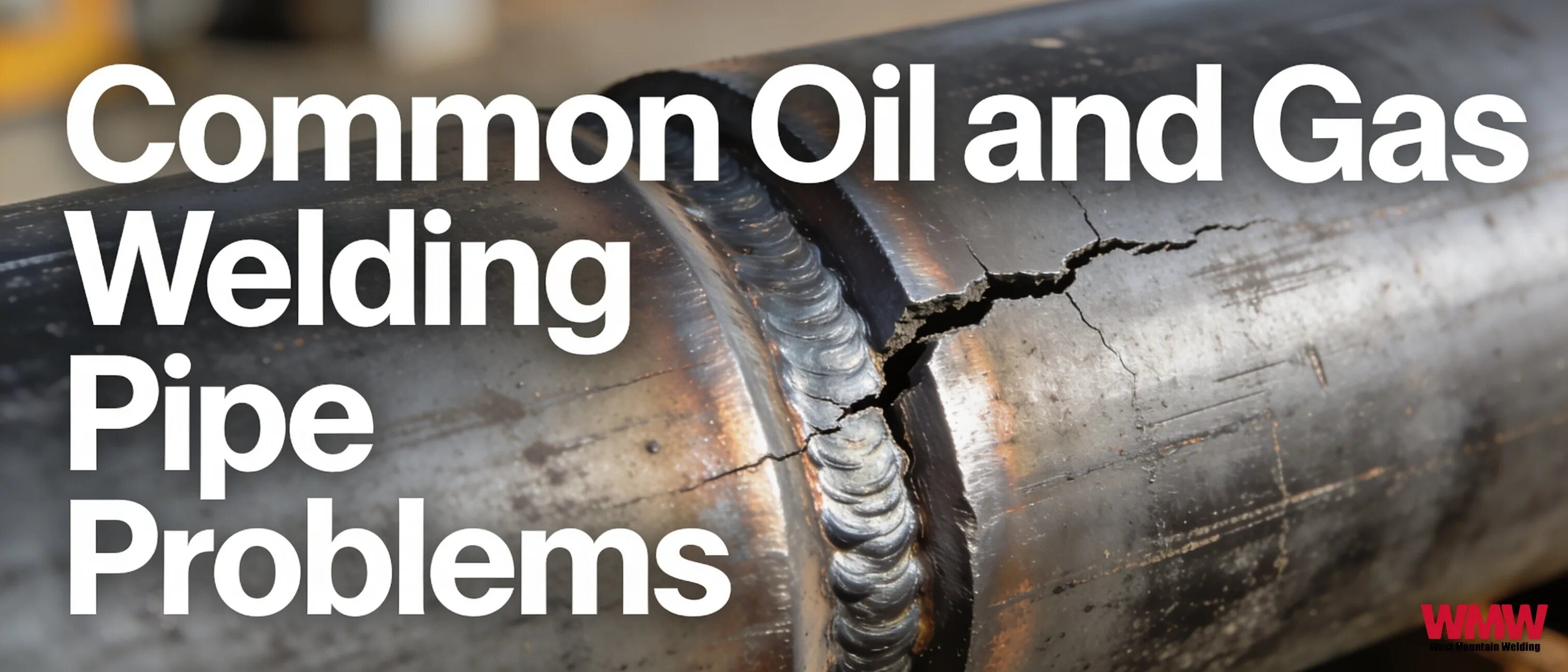
These are the issues that show up most often on pipeline and process piping jobs, and the ones a good pipeline welding inspection program is built to catch before they reach the field.
1. Poor Fit-up And Pipe Misalignment
Uneven gaps between pipe ends produce inconsistent root passes and stress concentrations at the joint. Mechanical line-up clamps solve this far more reliably than tack welds and eyeballing.
2. Unground Cut Edges After Plasma Or Oxyfuel Cutting
Both cutting methods leave an oxide layer on the joint face. That layer has a higher melting point than the base metal, so welding over it causes burn-through and incomplete fusion. Grinding the edge before welding removes the problem.
3. Incorrect Amperage Or Voltage Settings
Machine settings that don't match the wire diameter, material thickness, or process (GMAW, FCAW, GMAW-P, RMD) lead to incomplete penetration, excessive spatter, or burn-through.
4. Incomplete Fusion
When weld metal doesn't fully bond to the base material, it creates a hidden stress point that isn't visible from the surface. This is one of the most common welding defects in pipelines and one of the hardest to catch without proper inspection.
5. Porosity
Trapped gas voids in the weld metal weaken the joint's cross-section. Contaminated base metal, damp electrodes, or inadequate shielding gas coverage are the usual causes.
6. Cracking
Hot cracks form during solidification; cold cracks develop hours or days later, often from hydrogen embrittlement. Both propagate under load, which makes them especially dangerous in high-pressure or cyclic-service pipe.
7. Improper Bead Geometry
Undercut, overlap, and excessive reinforcement all concentrate stress at the toe of the weld. These usually trace back to incorrect travel speed, angle, or process settings.
8. Inconsistent Joint Geometry
Bevel angles, root gaps, and land dimensions that vary from joint to joint produce unpredictable penetration and make every weld a slightly different problem to solve.
9. Contaminated Or Poorly Maintained Welding Equipment
Dirty electrodes, worn tips, and uncalibrated machines introduce arc instability and defects directly into the weld pool, no matter how skilled the welder is.
Any one of these nine issues can compromise a joint on its own. In practice, they tend to show up in combination. A crew rushing to hit a schedule milestone is more likely to skip a grinding step, run a machine that's overdue for calibration, and rely on a visual fit-up check instead of a mechanical clamp, all on the same weld. That's how a single joint ends up carrying three defects instead of one.
Why Does Pipe Alignment Fail So Often?
Alignment problems are usually a tooling issue, not a skill issue. Crews under schedule pressure often rely on tack welds and visual checks instead of internal hydraulic or pneumatic line-up clamps. Without mechanical clamping, gaps drift out of tolerance, and every downstream pass has to compensate for a joint that was never square to begin with.
Accurate alignment before the first pass is one of the simplest ways to prevent oil and gas pipeline welding defects, and it costs far less than the rework that follows a bad fit-up.
What Happens When Cut Edges Aren't Properly Prepared?
Plasma and oxyfuel cutting are fast and effective for shaping pipe, but both processes leave an oxide layer on the cut face. That layer resists melting at the same rate as the surrounding base metal, so an arc that looks fine on the surface can still leave incomplete fusion underneath.
Grinding the joint face back to bright metal before welding removes the oxide, restores a consistent surface, and gives the welder a joint that behaves the way the procedure assumes it will.
Which Pipe Welding Defects Threaten Structural Integrity Most?
Not every defect carries the same risk. Incomplete fusion, porosity, and cracking sit at the top of the list because they compromise a joint's ability to hold pressure over time, often without any outward sign of trouble.
These defects tend to multiply on projects where crews are training new welders, adopting new materials, or under pressure to move faster than the process allows. That combination is exactly why pipeline welding inspection exists at every stage of a project, not just at final sign-off.
Cracking deserves particular attention because it behaves differently from most other defects. Hot cracks appear during or immediately after welding, usually from a combination of high restraint and impurities in the weld pool. Cold cracks can take hours or days to show up, driven by hydrogen that diffuses into the weld metal and stress that builds slowly at the grain boundaries.
A joint that passes visual inspection on the day it's made can still develop a cold crack before the line ever goes into service, which is why delayed inspection intervals matter as much as the initial check.
How Does Pipeline Welding Inspection Catch Problems Early?
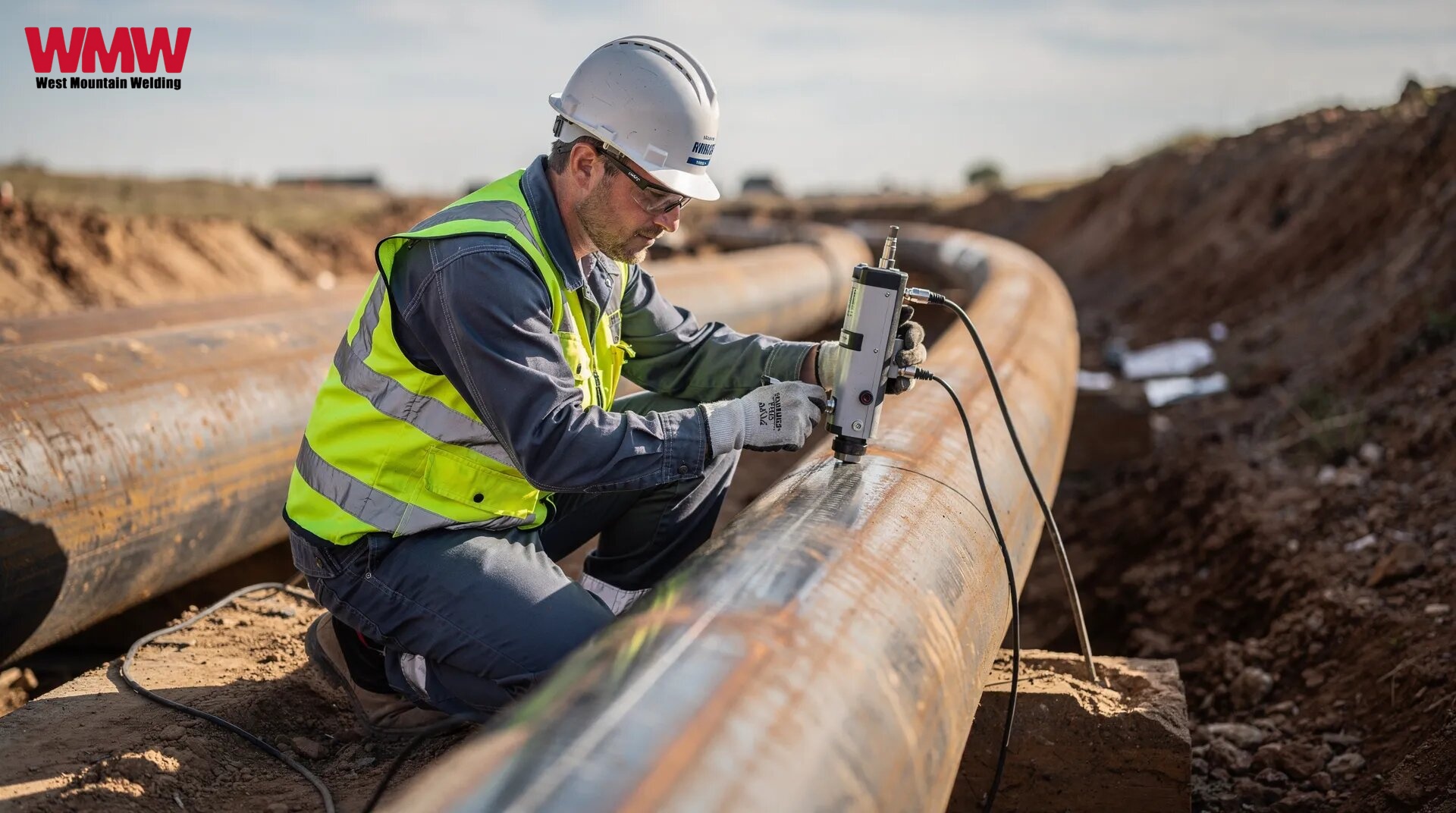
Pipeline welding inspection is built around a simple idea: a defect caught during fit-up or root-pass welding costs a fraction of what the same defect costs once it's found in the field. Subsurface flaws like lack of fusion, porosity, and cracking don't always show up to the naked eye. They surface under pressure, under load, or with time, usually at the worst possible moment.
Inspection at each stage of the weld, paired with documented procedure qualification, is what confirms a joint is sound before the system goes into service. West Mountain Welding executes oil and gas pipe welding and installation to API 1104 and ASME B31.1/B31.3 standards, with certified welders whose procedures and qualifications are available on request.
What Equipment Issues Cause the Most Common Pipe Welding Problems?
Even a skilled welder can't produce a clean joint on equipment that hasn't been maintained. Welding machines need to be calibrated to manufacturer specifications on a regular schedule, and electrodes and tips need to stay clean, since contamination at the tip disrupts arc stability and puts defects directly into the weld pool.
Routine checks on cables, connections, and cooling systems catch small problems before they turn into a mid-job breakdown. On a pipeline schedule, that kind of downtime is rarely just an inconvenience.
Common equipment checkpoints worth building into a maintenance routine include:
Machine calibration before each welding operation
Electrode and tip condition verified before arc initiation
Cable, connection, and cooling system checks on a set schedule
Shielding gas flow and coverage verified for the process in use
How Does Controlled Shop Fabrication Reduce Field Failures?
Controlled-environment fabrication removes a significant layer of risk before pipe ever reaches the job site. Shop conditions allow for tighter tolerances, consistent fit-up, and quality control that's harder to replicate in the field, where weather, access, and schedule pressure all work against precision.
West Mountain Welding delivers prefabricated piping systems with clear spool labeling and tight-tolerance shop work, so field crews receive components that are already verified and ready to install. Spools tagged directly to drawings let field inspectors cross-reference each piece against the design without guesswork.
How Can Certified Welding Teams Prevent Costly Rework?
Rework on a pipeline project is expensive twice over: once in labor to cut out and re-weld a failed joint, and again in the schedule time lost while that repair is certified and re-inspected. Certified welding teams avoid that cost by getting technique, machine settings, and fit-up right the first time.
A few practices consistently separate projects that stay on schedule from ones that don't:
Controlled-environment shop fabrication with tight tolerances
Clear spool labeling tied directly to project drawings
Certified welders working to applicable code standards
Fast field mobilization for repairs before defects compound
Building Reliability Into Every Joint
Oil and gas welding pipe problems share a common thread: nearly all of them are preventable. Fit-up, edge prep, machine calibration, and inspection aren't separate steps competing for time on a busy schedule; they're the sequence that determines if a weld holds for the life of the line or fails within its first year of service.
West Mountain Welding applies field-first practicality and disciplined quality control across new builds, retrofits, outage support, and urgent repairs, giving contractors and facility owners a single certified resource for the full project lifecycle.
Frequently Asked Questions
What causes most oil and gas pipe welds to fail?
Poor fit-up, unground cut edges, and incorrect machine settings are the most common causes of pipeline weld failures.
Contaminated Or Poorly Maintained Welding Equipment
It creates uneven gaps that produce inconsistent fusion, leading to weak joints and leaks.
What standard does West Mountain Welding follow for pipeline work?
West Mountain Welding executes oil and gas pipe welding to API 1104 and ASME B31.1/B31.3 standards.
Why is pipeline welding inspection necessary if a weld looks fine?
Many defects, like porosity and lack of fusion, are subsurface and only appear under pressure or over time.
Can shop fabrication reduce field welding defects?
Yes, controlled-environment fabrication improves tolerances and fit-up consistency before pipe reaches the job site.