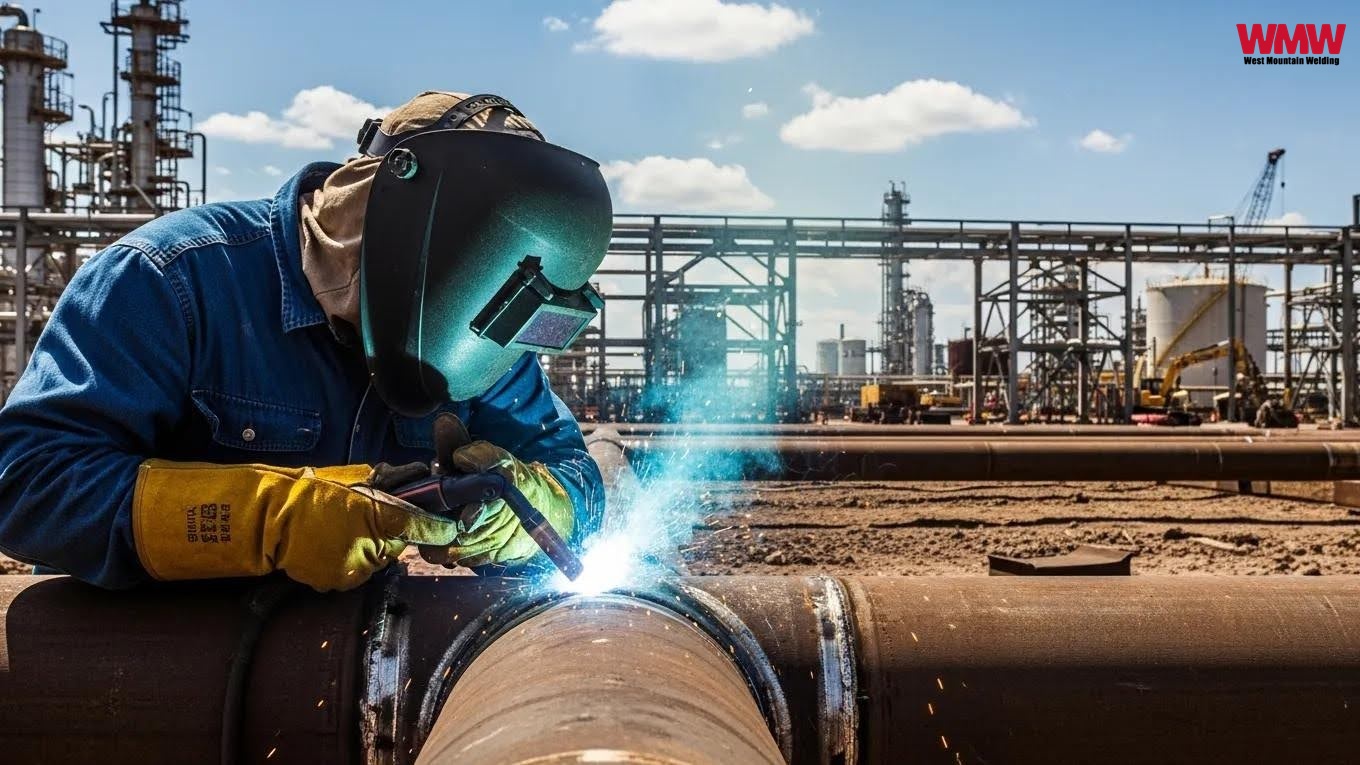
Top Welding Techniques Used in Oil and Gas Industries
Welding holds together every pipeline, pressure vessel, and structural component in the oil and gas sector. Choosing the wrong process or skipping proper inspection risks catastrophic failure, costly downtime, and serious safety incidents.
This guide covers the most critical welding techniques in the oil and gas industry, how each method works, where it excels, and the quality standards that keep operations safe and code-compliant.
Key Takeaways
TIG, MIG, stick (SMAW), submerged arc (SAW), and flux-cored (FCAW) welding are the foundational oil and gas welding methods.
TIG welding delivers the precision required for critical pipeline joints, root passes, and pressure-rated components.
Submerged arc welding maximizes productivity on heavy-wall pipe and structural steel through high deposition rates and automation capability.
API, ASME, and NACE codes govern welding procedures, welder qualifications, and inspection requirements across the industry.
Non-destructive testing (NDT) — radiography, ultrasonic testing, and magnetic particle inspection — is essential for verifying internal weld integrity.
Certified welding contractors bring validated procedures, documented quality control, and the experience needed to reduce risk on complex projects.
Common Welding Processes in Oil and Gas
Oil and gas fabrication requires processes capable of handling carbon steel, stainless steel, chrome-moly alloys, and duplex stainless steels under demanding service conditions. The five most widely used pipeline welding techniques are:
TIG Welding (GTAW)
The standard for precision root passes, thin-wall tubing, and any joint where quality cannot be compromised. Produces clean, spatter-free welds with excellent mechanical properties across virtually all alloys.
MIG Welding (GMAW)
Valued for speed and versatility on structural components, equipment skids, and large-scale fabrication, where production rates and moderate-to-heavy material thicknesses are the priority.
Stick Welding (SMAW)
Still the go-to for field repairs, remote pipeline work, and outdoor conditions where portability and process flexibility outweigh the benefits of wire-fed methods. Reliable across a broad range of alloys.
Submerged Arc Welding (SAW)
The shop fabrication workhorse for heavy-wall pipe, pressure vessels, and structural steel. A granular flux blanket shields the arc, enabling high deposition rates, deep penetration, and a clean weld profile with minimal fume.
Flux-Cored Arc Welding (FCAW)
Bridges the gap between SMAW and GMAW, with higher deposition than stick, and good performance in outdoor or windy conditions. Common on structural components and pipeline tie-ins.
Understanding which process suits a specific application based on material, position, wall thickness, and service environment is what separates quality fabrication from expensive rework. In practice, many oil and gas projects use two or more processes in combination, with each assigned to the phase of welding where it performs best.
TIG Welding: Precision for Critical Joints
TIG is the gold standard wherever joint integrity is non-negotiable: high-pressure pipe headers, instrumentation tubing, heat exchanger components, valve bodies, and root passes on large-diameter welds later completed by SMAW or FCAW.
Precision arc control allows welders to independently manage heat input and filler metal addition in real time, essential on stainless and alloy steels, where heat input directly affects corrosion resistance and mechanical properties.
Material versatility means TIG works across carbon steel, 316L and duplex stainless, aluminum, titanium, chrome-moly alloys (P91, P22), and nickel alloys, all common in oil and gas processing equipment.
Clean, low-defect welds with no spatter and minimal oxidation routinely meet radiographic quality standards, reducing post-weld cleanup and repair costs.
For oilfield pipe welding, specifying TIG for the root pass and a faster-filling process for fill and cap passes is a widely used strategy that balances quality and production speed. On high-alloy materials such as duplex stainless steel or chrome-moly, TIG may be required for all passes to maintain the strict interpass temperature and heat input controls the material demands.
Submerged Arc Welding: High-Output Heavy Fabrication
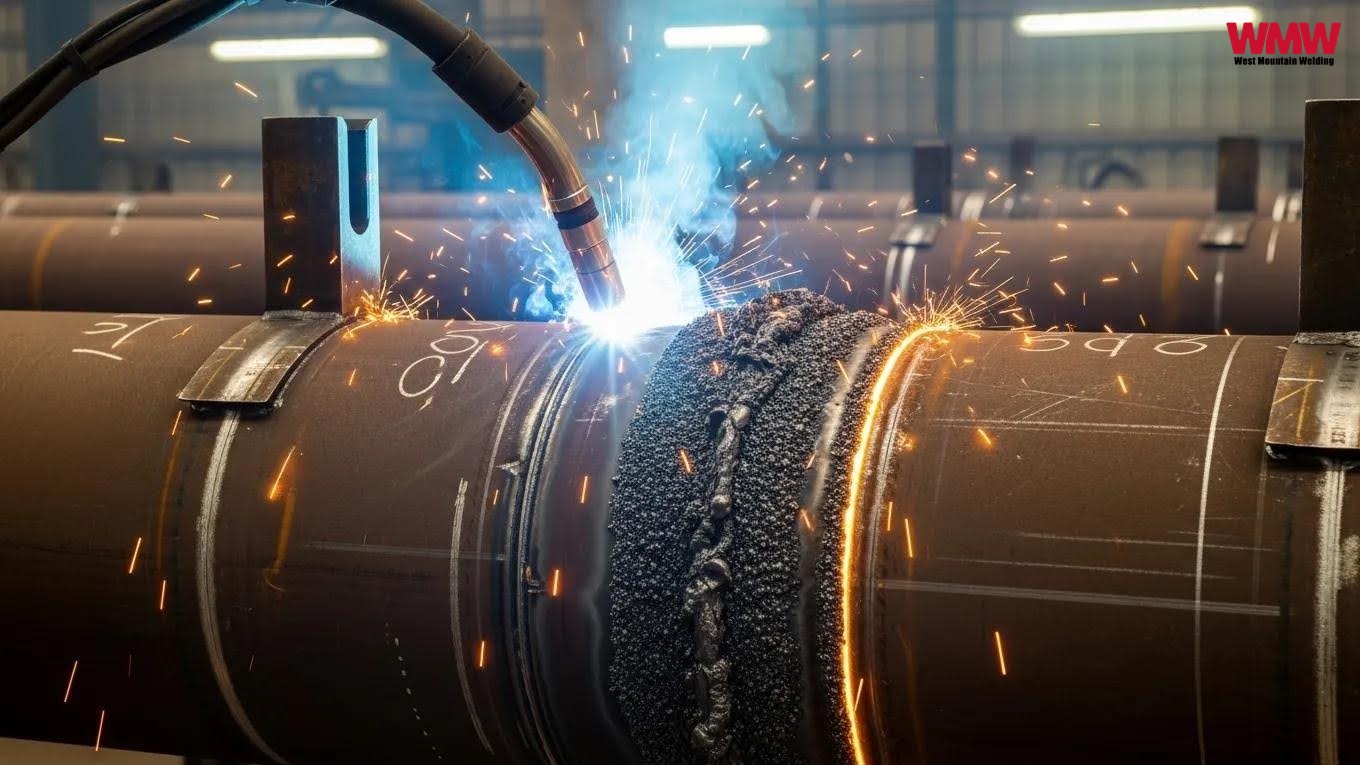
Where TIG excels in precision, SAW excels in volume and heavy sections. A continuously fed wire electrode buried under granular flux means the arc is never exposed to the atmosphere, eliminating most porosity and contamination risks that affect open-arc processes.
High deposition rates enable faster fabrication of large-diameter pipelines, storage tank shells, and pressure vessel bodies, translating directly to lower cost per joint on thick-wall work.
Deep penetration produces thorough fusion in heavy base material without excessive joint preparation or pass count.
Automation capability allows mechanized SAW systems to maintain consistent travel speed, wire feed rate, and arc voltage pass after pass, reducing operator variability across long production runs.
Research on SAW optimization, including studies on ASTM A516 Gr.70 carbon steel used in pressure vessels, confirms that controlling heat input, travel speed, and flux composition is a prerequisite for consistent weld quality in high-volume industrial welding for oil and gas.
Welding Standards and Codes
No discussion of oilfield welding is complete without the regulatory framework. Key standards include:
Key Welding Standards for Oil and Gas Projects
API 1104 – Covers pipeline welding and is used to qualify welding procedures and welders for pipeline construction projects.
ASME BPVC Section IX – Applies to pressure equipment welding and is required for the fabrication of pressure vessels and process piping.
ASME B31.3 – Governs process piping systems commonly found in refineries, chemical plants, and other industrial facilities.
AWS D1.1 – Addresses structural steel welding requirements for platforms, pipe racks, structural supports, and related infrastructure.
NACE MR0175 – Establishes requirements for sour service environments containing hydrogen sulfide (H₂S), including weld hardness limits to help prevent sulfide stress cracking.
Before any production welding begins, the applicable code requires a documented Welding Procedure Specification (WPS) that specifies base materials, filler metals, preheat, and interpass temperatures, supported by a Procedure Qualification Record (PQR) from mechanical testing. Individual welders must also hold current performance qualifications for the specific process and position required.
These are not administrative formalities; they are the evidence base that regulators, insurers, and project owners rely on to confirm a weld is safe. Without them, the project cannot be handed over, insured, or brought into service under most operating company requirements.
Welding Inspection and NDT
Weld quality must be verified, not assumed. Welding inspection in oil and gas combines visual examination with non-destructive testing at defined hold points throughout the fabrication process.
Radiographic Testing (RT) uses X-ray or gamma-ray imaging to reveal internal defects, porosity, slag, lack of fusion, and cracks in pressure-containing butt welds.
Phased Array Ultrasonic Testing (PAUT) has largely replaced conventional RT on pipeline and pressure vessel work, providing 3D defect characterization without radiation hazards.
Magnetic Particle Inspection (MPI) detects surface and near-surface discontinuities in ferromagnetic materials, commonly applied to structural welds and equipment supports.
Liquid Penetrant Testing (PT) reveals surface-breaking defects on stainless steel, aluminum, and other non-ferrous materials where MPI is ineffective.
A rigorous NDT program calibrated to the applicable code and executed at defined inspection points is what separates compliant oilfield welding from work that looks acceptable but fails in service. Industry best practice combines multiple NDT methods on critical joints, using each technique's strengths to compensate for the limitations of others. RT excels at detecting volumetric defects; PAUT provides superior crack detection and sizing; MPI catches surface flaws that RT can miss.
Advanced Welding Technologies
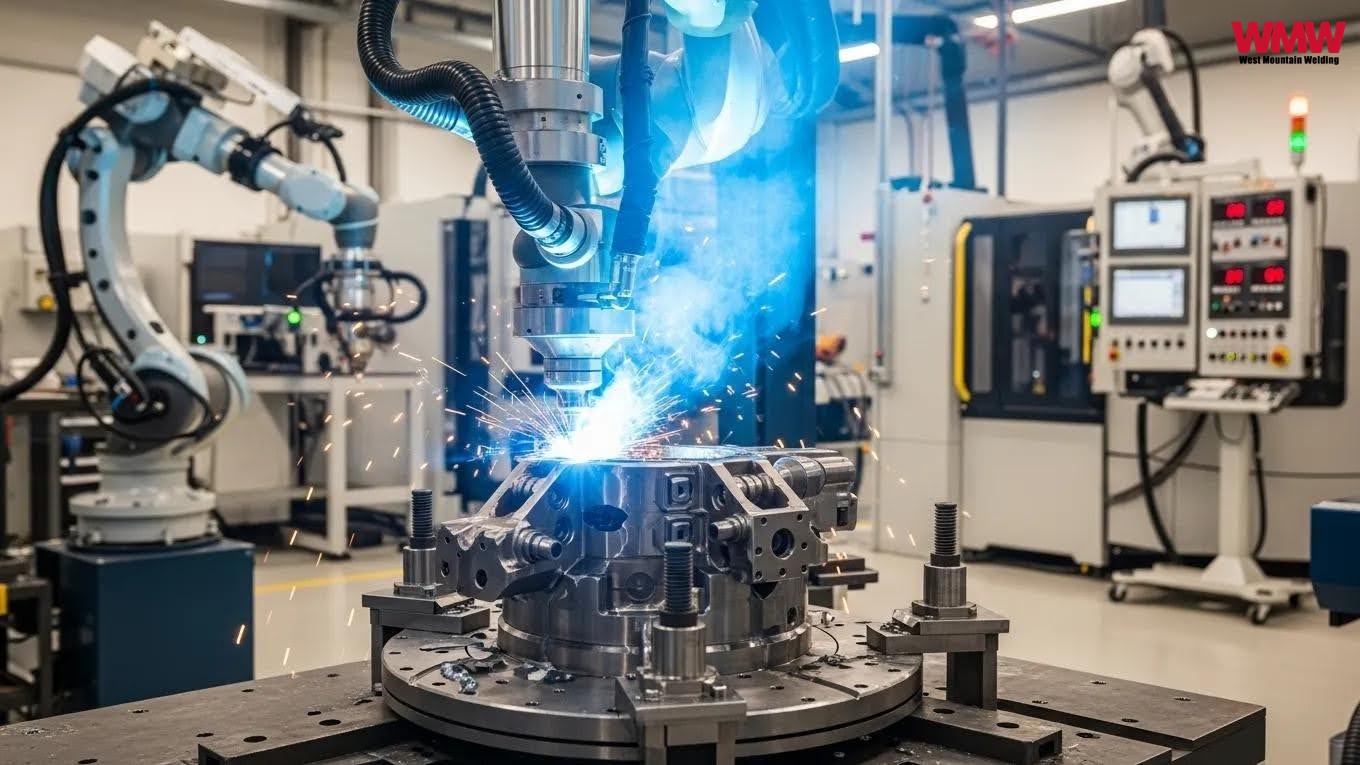
Several emerging technologies are improving efficiency and consistency across oilfield fabrication:
Robotic and mechanized welding eliminates human variables from repetitive joints, delivering consistent bead geometry and heat input from first weld to last. Widely adopted in high-volume pipe spool and pressure vessel shops.
Laser and hybrid laser-arc welding combine a focused laser beam with a conventional arc process (typically GMAW or SAW) to achieve deep penetration and high deposition in a single pass, particularly effective on thick-wall pipe and structural sections.
Real-time weld monitoring uses sensors tracking arc current, voltage, and travel speed to flag process deviations before they become defects, while creating a traceable quality record for every joint.
These technologies are raising productivity benchmarks and reducing defect rates across the sector, particularly on high-volume fabrication programs where consistency and speed are equally critical. Contractors investing in these capabilities are better positioned to meet tightening schedule requirements and increasingly stringent inspection acceptance criteria without proportional increases in labor cost.
What Certified Welding Contractors Bring to Oil and Gas Projects
Selecting an experienced, certified contractor is one of the highest-leverage decisions on any oil and gas fabrication project.
Documented WPS/PQR packages covering the materials and processes relevant to your work — available for owner and inspector review before fabrication starts.
Qualified welders holding current performance qualifications in the positions and processes the project requires, with documented qualification histories.
Formal quality management systems define inspection hold points, documentation requirements, and non-conformance management.
Material traceability, maintaining chain-of-custody from certified mill test reports through to the finished weld a requirement on critical oil and gas fabrication that general contractors rarely have systems to support.
Choosing a contractor on price alone, without verifying qualifications and quality systems, introduces risk that typically surfaces as expensive rework, schedule overruns, or, in the worst case, field failures that endanger personnel and trigger regulatory scrutiny. The cost differential between a qualified contractor and a cheaper alternative is almost always recovered on a single avoided repair or re-inspection event.
Conclusion
Understanding the welding techniques used in oil and gas industries, from TIG root passes on stainless process piping to high-deposition SAW on heavy-wall transmission pipe, is foundational to building infrastructure that performs safely over decades of service. The processes themselves are only as reliable as the procedures, qualifications, and inspection systems behind them.
Working with certified welding contractors who bring documented procedures, qualified personnel, and rigorous quality control is the most reliable path to pipelines, pressure vessels, and structural components that meet the safety and performance standards the industry demands.
Frequently Asked Questions
1. What is the most important welding technique in oil and gas?
TIG welding (GTAW) is critical for high-integrity joints due to its precision, but SAW is equally important for high-volume heavy fabrication. The right choice depends on material, joint configuration, and service conditions.
2. Which welding code applies to oil and gas pipelines?
API 1104 is the primary standard. ASME B31.4 and B31.8 govern liquid and gas transmission piping design, and reference API 1104 for welding requirements.
3. What is NDT, and why is it required in oilfield welding?
Non-destructive testing evaluates weld integrity using radiography, ultrasonic testing, or magnetic particle inspection without damaging the component. Internal defects invisible to the eye can cause failures under pressure or cyclic loading.
4. How does sour service affect welding requirements?
Welds in H₂S service must meet maximum hardness limits per NACE MR0175/ISO 15156 to resist sulfide stress cracking, typically requiring controlled heat input, post-weld heat treatment (PWHT), and hardness verification testing.
5. What qualifications should a welding contractor have for oil and gas work?
Look for API- or ASME-qualified WPS/PQR documentation, individually qualified welders, a formal quality management system, and demonstrated experience with the materials and service conditions specific to your project.