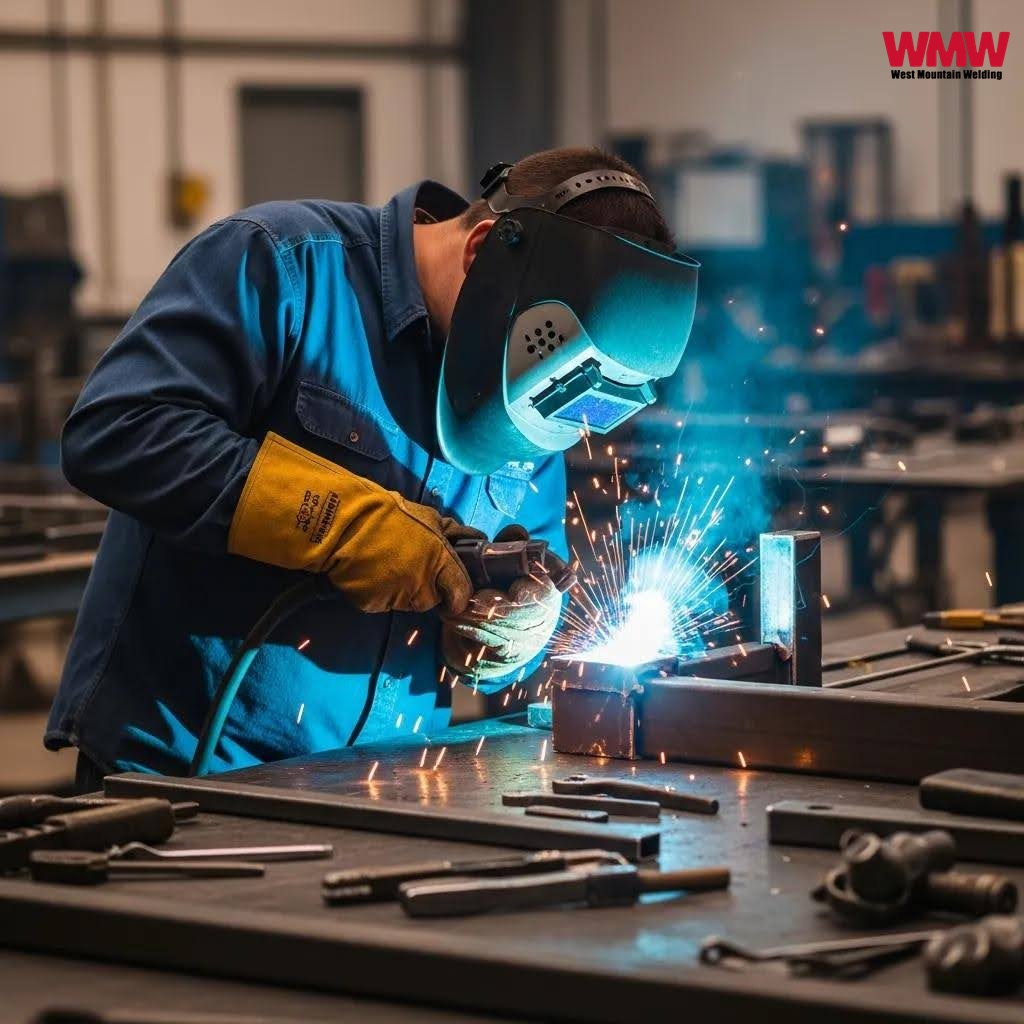
High Quality Welding & Fabrication Services in West Mountain
When a structural weld fails, the consequences are never minor: delayed timelines, compromised safety, and costly rework. That is why contractors, utility companies, and EPC firms across the Mountain West turn to West Mountain Welding for dependable welding and fabrication services in West Mountain that hold up under real industrial pressure.
This guide covers everything you need to know: the specific services available locally, the welding techniques used for precision results, the certifications that back every project, and the industries we serve. Whether you need structural steel welding, custom metal fabrication in West Mountain, or a certified partner for a large infrastructure project, this is your starting point.
Key Takeaways
West Mountain Welding delivers custom welding, structural steel fabrication, and precision metalwork for contractors, utility companies, and EPC firms.
MIG, TIG, and Stick welding methods are selected based on material type, project scale, and environment.
AWS and ASME certifications validate every welding procedure and operator qualification on-site.
Robotic welding and CAD-integrated fabrication improve consistency, reduce rework, and speed up turnaround.
Serving construction, energy, and manufacturing sectors across the Mountain West region.
End-to-end service from design through final fabrication keeps projects on schedule and within spec.
What Welding and Fabrication Services Are Available in West Mountain?
West Mountain Welding provides a complete range of welding services in West Mountain and surrounding areas, built specifically for industrial and commercial clients who cannot afford shortcuts. Core offerings include:
Custom metal fabrication — producing metal components and assemblies to exact project specifications, including tight tolerances for structural and mechanical applications
Structural steel welding — joining steel sections for building frameworks, bridges, industrial platforms, and heavy infrastructure
Pipe welding — used extensively in the energy and utility sectors for high-pressure and high-temperature systems
Repair and maintenance welding — restoring worn or damaged components to extend service life and reduce replacement costs
Precision sheet metal work — for enclosures, brackets, frames, and custom components requiring clean, accurate welds
Each service is executed by certified welders using current equipment and documented procedures, ensuring traceability and compliance on every job.
What Makes West Mountain Welding Different?
Three factors consistently set West Mountain Welding apart from general fabrication shops: certified operators, documented weld procedures, and regional availability. When a project requires compliance with AWS or ASME standards, as most industrial and infrastructure jobs do, having a locally based, certified fabricator eliminates the delays and coordination gaps that come with out-of-state contractors.
Which Welding Techniques Ensure Precision in West Mountain Projects?
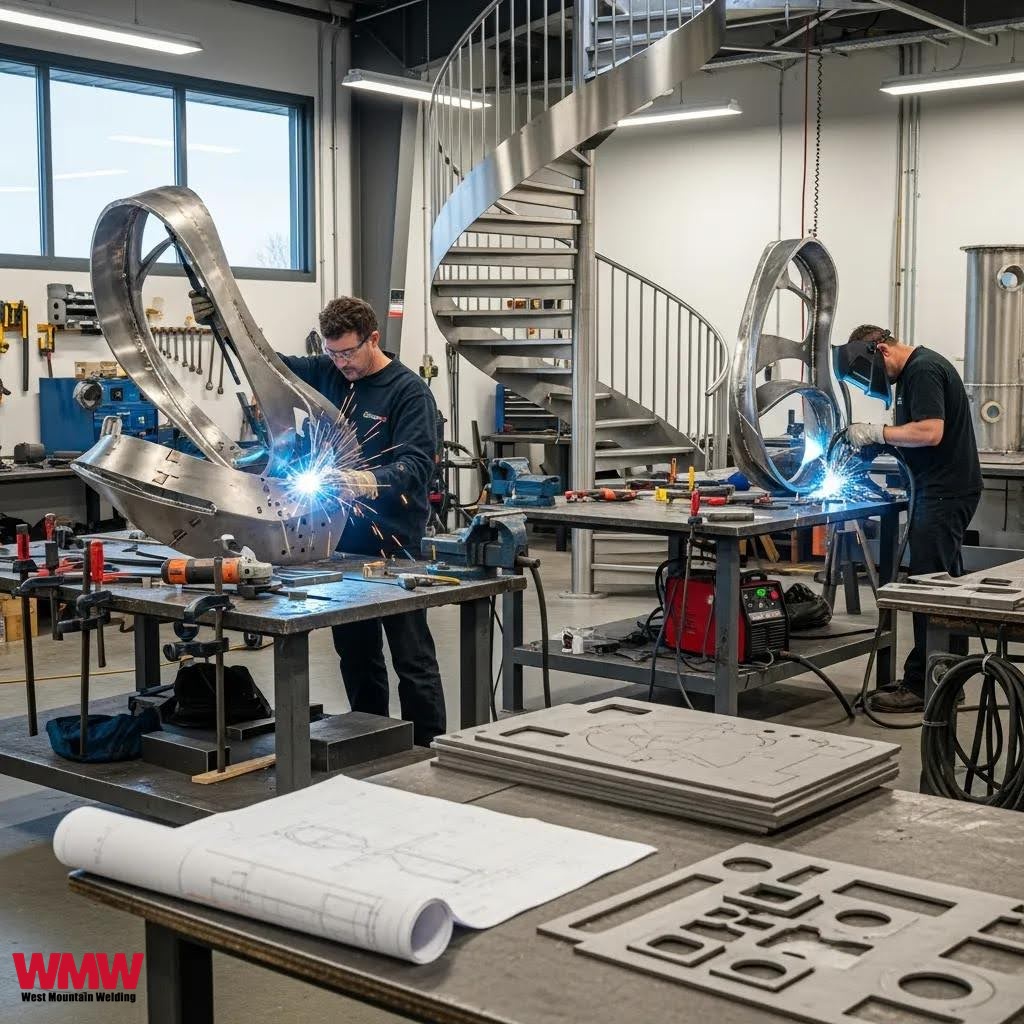
Selecting the right welding process directly affects weld quality, strength, and project cost. West Mountain Welding uses three primary methods, each matched to the demands of the application.
MIG, TIG, and Stick Welding: A Direct Comparison
MIG (Metal Inert Gas) welding is a fast and efficient method, making it ideal for thick materials and high-volume production. It is commonly used in structural steel work, automotive manufacturing, and large-scale fabrication projects.
TIG (Tungsten Inert Gas) welding is known for its high precision and ability to produce clean, high-quality welds. It is especially suitable for thin or exotic materials and is often used in aerospace components, stainless steel work, and artistic metal fabrication.
Stick (SMAW) welding is highly versatile and performs well in outdoor or harsh conditions. It is weather-resistant and effective on rusty or coated metals, making it a popular choice for field repairs, outdoor infrastructure, and work in remote locations.
MIG welding is the workhorse for production-scale structural work in West Mountain. TIG welding is specified when weld quality must meet exacting visual and mechanical standards, particularly for stainless steel and aluminum in the energy and food processing sectors. Stick welding remains the go-to for field repairs and for site conditions where wind and contamination would compromise shielding-gas processes.
A 2023 critical review of TIG and MIG welding applications found that both processes are well established in aerospace, automotive, and food packaging industries, and that integrating friction stir processes with TIG/MIG welding offers promising improvements for fatigue behavior in aluminum alloy joints, a finding relevant to fabricators working with lightweight structural materials.
How Advanced Fabrication Technologies Improve Welding Outcomes
Modern metal fabrication in West Mountain goes well beyond torch and rod. West Mountain Welding integrates advanced fabrication technologies to improve consistency and throughput on every project.
Robotic Welding and Automated Fabrication
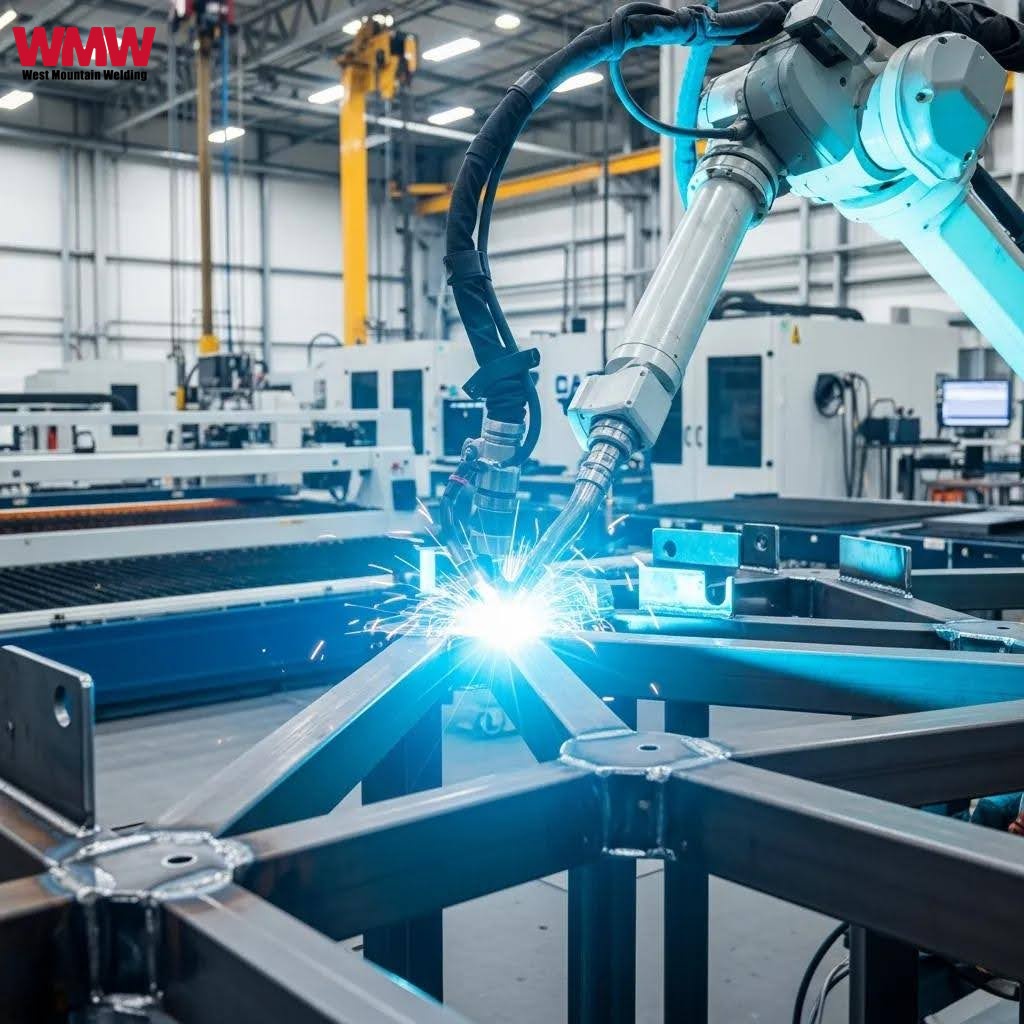
Robotic welding systems perform repetitive weld passes with a level of consistency that manual welding cannot sustain across long production runs. Industrial machinery studies confirm that robotic welding can deliver more than double the output of manual welding on repetitive tasks, while operating in hazardous environments and maintaining high dimensional accuracy across complex geometries.
For clients running high-volume structural components or repeat orders, automated fabrication reduces per-unit cost, tightens tolerances, and eliminates the variability introduced by operator fatigue.
CAD-Integrated Design and Fabrication
Computer-aided design (CAD) is integrated into the fabrication workflow at West Mountain Welding from the earliest stages of the project. This means dimensional data flows directly from design to cutting, bending, and welding, reducing transcription errors and allowing complex assemblies to be validated digitally before the first piece of steel is cut.
Laser cutting and CNC plasma cutting complement welding operations, producing clean, accurate blanks that fit together precisely and reduce weld preparation time.
What Safety and Certification Standards Does West Mountain Welding Follow?
Certifications are not marketing credentials. In industrial welding, there are contractual requirements and legal safeguards. West Mountain Welding maintains active certifications and enforces documented safety protocols on every project.
AWS and ASME Certifications Explained
AWS (American Welding Society) certification, specifically AWS B2.1, the Specification for Welding Procedure and Performance Qualification, governs how welding procedures are written, tested, and qualified. It ensures that the weld parameters used on a job have been validated to produce sound welds under defined conditions.
ASME Section IX — the Qualification Standard for Welding, Brazing, and Fusing Procedures is the standard required for pressure vessel and piping work. Compliance with ASME Section IX is mandatory for energy-sector clients operating pressurized systems.
Holding both AWS and ASME qualifications means West Mountain Welding can take on the full range of industrial welding work from structural steel to high-pressure piping without requiring clients to source multiple vendors.
On-Site Safety Protocols
Safety practices at West Mountain Welding include:
Mandatory PPE — welding helmets, flame-resistant clothing, gloves, and respiratory protection as required by the task
Pre-job hazard analysis — reviewing site conditions, material types, and process risks before work begins
Regular operator training and qualification testing — ensuring all welders maintain current certifications
Compliance with OSHA 1910.252 and 1926.350 — the federal standards governing welding, cutting, and brazing in general industry and construction
These protocols protect workers, reduce incident-related project delays, and give clients documented evidence of due diligence.
Which Industries Does West Mountain Welding Serve?
Welding services in West Mountain are not one-size-fits-all. West Mountain Welding structures its services around the distinct technical and regulatory requirements of each sector.
1. Construction
Structural steel fabrication for commercial and industrial buildings, bridges, parking structures, and infrastructure projects. Work is performed in compliance with local building codes and AWS D1.1 (Structural Welding Code — Steel), the governing standard for structural steel welds.
2. Energy and Utilities
Pipe welding, pressure vessel fabrication, and field repair services for utility companies and energy producers. Projects in this sector require ASME Section IX-qualified procedures and welders, along with rigorous non-destructive testing (NDT) to verify weld integrity before commissioning.
3. Manufacturing
Custom fabrication of machine frames, equipment guards, conveyors, brackets, and production tooling. Tight tolerances and repeatable quality are the priorities here, supported by CNC cutting and robotic welding capabilities.
4. EPC Firms and General Contractors
Engineering, Procurement, and Construction firms frequently rely on West Mountain Welding as a subcontractor for specialized fabrication scopes. The ability to work from engineering drawings, meet ITP (Inspection and Test Plan) requirements, and provide full weld traceability documentation makes West Mountain Welding a practical fit for complex EPC project structures.
Why Choose West Mountain Welding for Custom Metal Fabrication Near You?
Proximity to the job site matters in fabrication. Sourcing custom metal fabrication in West Mountain locally reduces freight costs, shortens lead times for revisions, and gives you a direct line to the team producing your components.
Local Expertise in the Mountain West Region
West Mountain Welding operates with knowledge of regional factors that out-of-state shops simply do not have: local building codes, state-specific regulatory requirements, regional material suppliers, and the logistical realities of Mountain West project sites. This local expertise translates directly into smoother permitting, faster material sourcing, and project execution that accounts for site-specific conditions.
End-to-End Service: Design Through Fabrication
West Mountain Welding manages projects from initial design consultation through final fabrication and quality inspection. This integrated model eliminates the miscommunication that occurs when design and fabrication are handled by separate vendors. Clients receive a single point of contact, regular progress updates, and a finished product that matches the original specification.
Latest Trends in Welding and Fabrication Services in West Mountain
The welding and fabrication industry is evolving faster than at any point in recent memory. Understanding these trends helps clients make better decisions when selecting fabrication partners.
Automation and Robotic Welding Adoption
Welding automation is expanding from large OEM manufacturers into mid-size regional fabrication shops. For clients, this means access to robotic welding precision without the overhead costs of maintaining their own automated systems. West Mountain Welding's investment in automation positions clients to benefit from faster turnaround and tighter weld consistency.
Advanced and High-Strength Steel Materials
Infrastructure and energy projects increasingly specify high-strength low-alloy (HSLA) steels and advanced stainless alloys that reduce structural weight while maintaining load capacity. These materials require carefully controlled heat input and specific filler metals, expertise that certified fabricators develop through formal procedure qualification, not trial and error on the job site.
Sustainability and Waste Reduction in Fabrication
Modern fabrication shops are reducing material waste through nesting software that optimizes cut layouts, plasma and laser cutting that minimizes kerf loss, and recycling programs for metal offcuts and weld spatter. For clients with sustainability reporting requirements, working with a fabricator that documents material efficiency is increasingly relevant.
Growing Demand for Certified Welding Services in Infrastructure
As public infrastructure funding increases across the Mountain West, demand for certified welding services capable of meeting federal and state project standards is rising. Clients who pre-qualify vendors with current AWS and ASME certifications avoid costly last-minute qualification failures that delay project starts.
Conclusion
Reliable welding and fabrication services in West Mountain require more than a welder and a machine; they require certified procedures, documented quality systems, modern equipment, and operators who understand the specific demands of industrial and infrastructure work. West Mountain Welding delivers all of it under one roof, with the regional knowledge and end-to-end service model that keeps complex projects on track.
For contractors, utility companies, EPC firms, and manufacturers in the Mountain West, West Mountain Welding is the local partner built for the work that cannot fail.
Ready to get your oil and gas welding project underway? Contact West Mountain Welding today to discuss your project requirements and get dependable, professional welding support.
FAQ About Welding and Fabrication Services in West Mountain
1. What types of metals does West Mountain Welding work with?
West Mountain Welding works with carbon steel, stainless steel, aluminum, and high-strength alloy steels across structural, piping, and custom fabrication applications.
2. Does West Mountain Welding handle both small custom jobs and large industrial contracts?
Yes. The shop is equipped for single-component custom fabrication as well as large-scale structural and industrial projects requiring full weld procedure documentation and third-party inspection.
3. What certifications should I look for when hiring a welding contractor in West Mountain?
Look for AWS-certified welders and ASME Section IX-qualified procedures, particularly for structural steel and pressure-related work. West Mountain Welding holds both.
4. How long does a custom metal fabrication project typically take?
Lead times depend on project complexity, material availability, and finishing requirements. West Mountain Welding provides project-specific timelines during the initial consultation.
5. Does West Mountain Welding offer on-site welding services, or only shop fabrication?
Both. West Mountain Welding provides shop fabrication and field welding services, including on-site repair and installation welding for construction and utility clients.