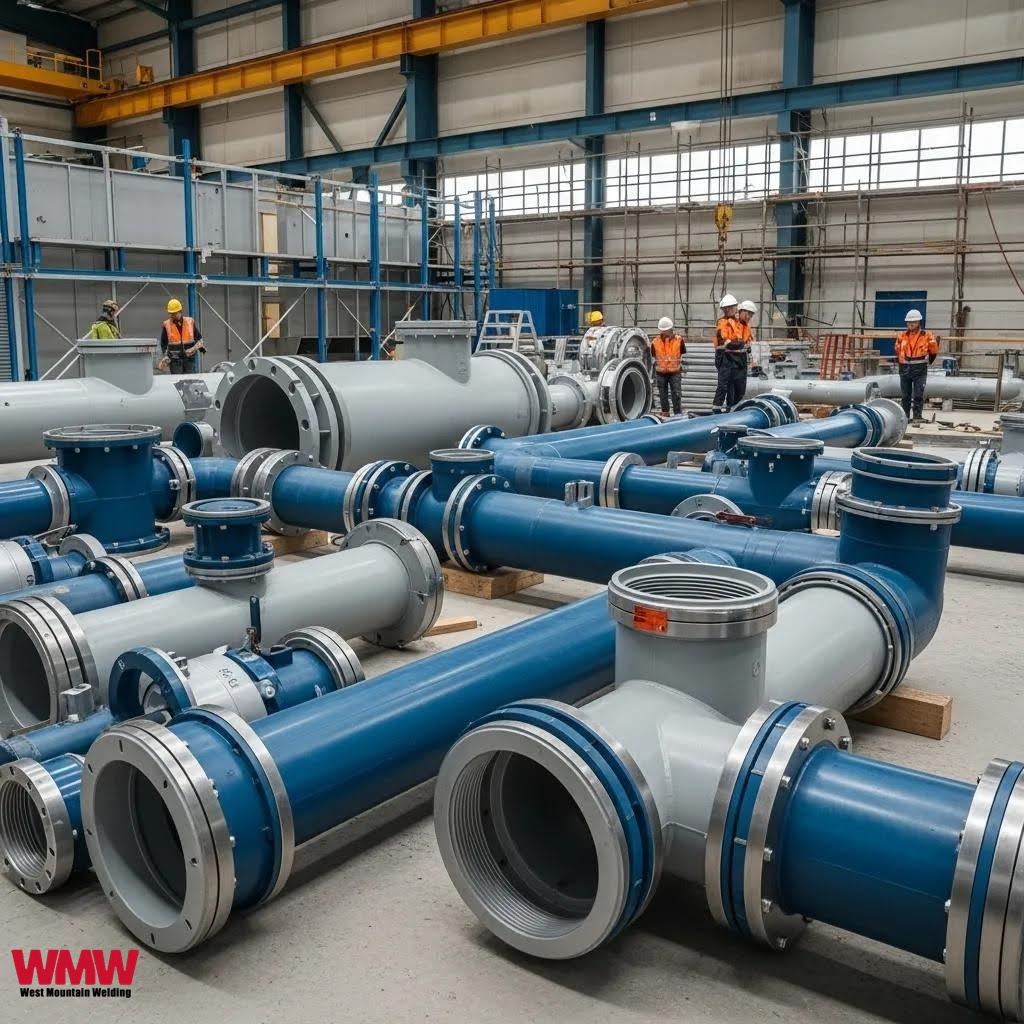
What Is Prefabricated Pipe System and Its Key Advantages
Industrial construction projects demand precision, speed, and cost control, and a prefabricated pipe system delivers all three. Rather than cutting, fitting, and welding pipe sections directly on-site, prefabrication moves that work into a controlled shop environment, producing finished pipe assemblies that arrive ready to connect. At West Mountain Welding, we apply decades of hands-on fabrication expertise to deliver modular piping solutions that hold up under demanding industrial conditions.
This guide breaks down how prefabricated pipe systems are defined, how the pipework prefabrication process works, and why industries from oil and gas to municipal water treatment are making the switch from traditional field assembly.
What Is a Prefabricated Pipe System?
A prefabricated pipe system is a network of pipe spools, fittings, flanges, and valves that are cut, welded, and assembled in a fabrication shop before being transported to the project site. Each assembly is built to exact engineering specifications, including dimensional drawings, material grades, and pressure ratings, and undergoes quality inspection before it leaves the facility.
This approach stands in contrast to stick-built or field-fabricated piping, in which raw materials are delivered to the job site and assembled on site. Off-site fabrication eliminates many of the variables that drive up cost and slow down traditional field work: weather delays, congested work areas, inconsistent welder access, and compressed inspection windows.
The result is a pipe assembly system engineered and tested before installation day, reducing the unknowns that can derail industrial construction schedules.
How the Pipework Prefabrication Process Works
The pipework prefabrication process follows a structured sequence from engineering to delivery. Understanding each phase helps project managers and procurement teams set realistic expectations and coordinate efficiently with their fabrication partner.
1. Design and Isometric Drawing Review
Fabrication begins with isometric drawings and piping and instrumentation diagrams (P&IDs). The fabrication team reviews dimensional data, material specifications, and pressure class requirements before cutting a single piece of pipe. Errors caught at this stage cost minutes; errors caught on-site cost days.
2. Material Procurement and Traceability
Pipe, fittings, flanges, and valves are sourced to the specified material standard: carbon steel, stainless steel, duplex, or specialty alloys. Mill test reports (MTRs) are verified and filed, maintaining full material traceability for compliance documentation.
3. Pipe Spool Fabrication
Individual pipe spools are cut to length, beveled, and fitted together using precision fit-up techniques. Spool fabrication accounts for tolerances across connected assemblies to ensure that field connections close up cleanly without forcing or shimming.
4. Welding and Inspection
Welds are completed using the method best suited to the pipe material, wall thickness, and service conditions: TIG (GTAW) for precise root passes on thin-wall and stainless applications, MIG (GMAW) for productivity on carbon steel, and submerged arc welding (SAW) for large-diameter, high-volume applications. All welds are inspected per the applicable code, visual, radiographic (RT), ultrasonic (UT), or hydrostatic testing as required.
5. Surface Treatment and Marking
Completed spools are cleaned, primed, or coated to specification. Each spool is marked with a unique identifier that corresponds to the isometric drawing, making field installation a matter of matching numbers rather than re-measuring and re-fitting.
6. Packaging and Logistics
Finished assemblies are packaged, protected, and staged for delivery. Sequenced delivery: spools arrive in the order they will be installed, minimizing laydown area requirements and keeping the site moving.
Modular Piping Systems: Applications Across Industries
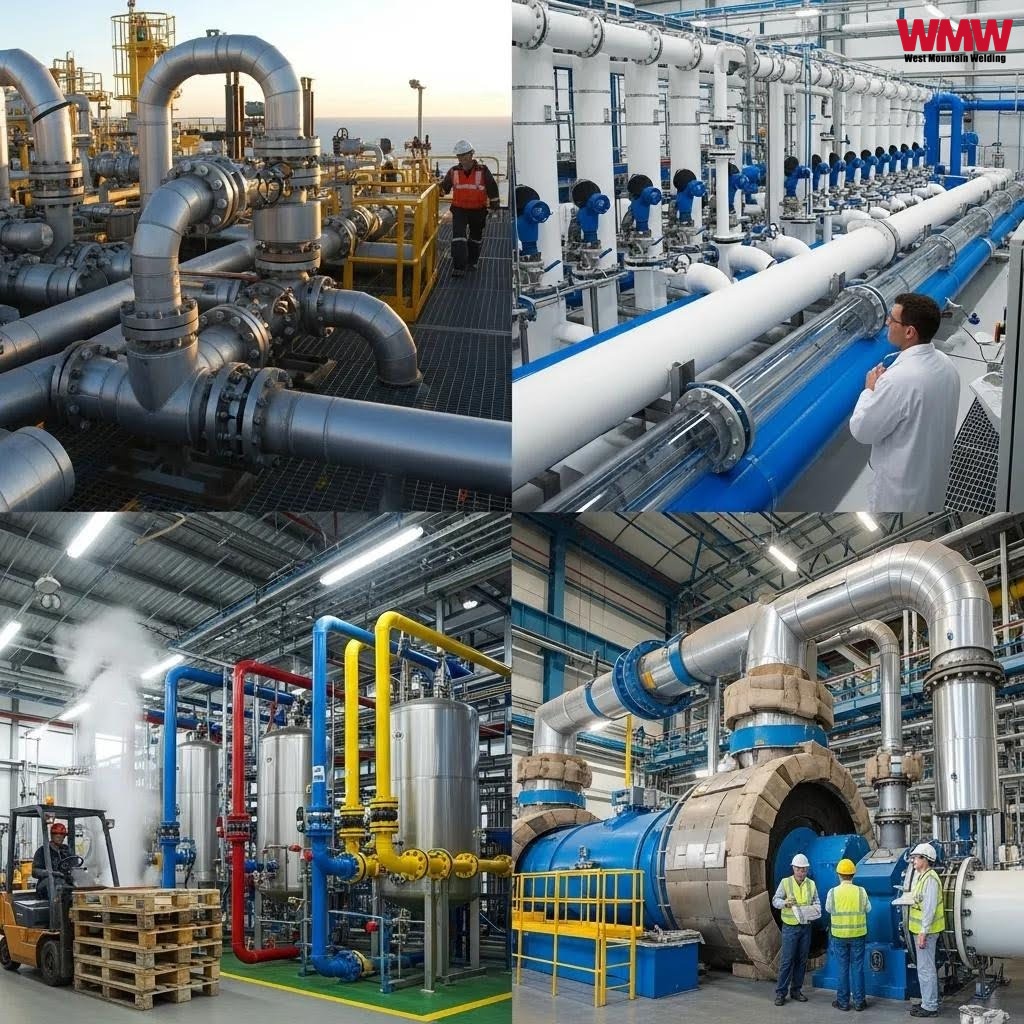
Modular piping systems are used wherever process reliability, installation speed, and regulatory compliance are non-negotiable. Common industrial sectors include:
Oil and Gas — Upstream wellsite skids, midstream gathering and compression facilities, and downstream refinery piping all benefit from fabricated pipe assemblies built to API and ASME B31.3 process piping standards.
Water and Wastewater Treatment — Municipal and industrial water treatment plants use prefabricated carbon steel, stainless, and FRP pipe systems for filtration, chemical dosing, and distribution headers. Shop fabrication simplifies work in confined mechanical rooms.
Chemical and Petrochemical Processing — Corrosive, high-temperature, and high-pressure service conditions demand tight weld quality and documented traceability. Prefabrication under controlled conditions meets those demands more reliably than field assembly.
Power Generation — Steam, cooling water, and condensate return piping in power plants require dimensional accuracy across long runs and adherence to ASME B31.1 power piping code. Prefabricated spools reduce outage duration during plant construction or turnaround.
Mining and Minerals Processing — High-wear and corrosion-resistant alloy piping for slurry, acid, and reagent service is fabricated off-site to minimize rework in remote or difficult-access locations.
Key Advantages of Prefabricated Pipe Systems
1. Reduced On-Site Labour and Improved Site Safety
When the welding, fitting, and inspection work is done in the shop, fewer trade workers are needed on-site during installation. This directly reduces labour cost per installed foot of pipe and shrinks the site headcount that needs to be managed, inducted, and supervised. Fewer workers in active construction zones also reduces the exposure to elevated work, confined spaces, and moving equipment, the conditions that generate the majority of industrial site incidents.
2. Faster Installation and Shorter Project Schedules
Modular piping systems arrive labeled, sequenced, and ready to connect. Site crews bolt flanges, make final tie-ins, and commission rather than measure, cut, and weld from raw stock. Projects that would have required weeks of field pipe fitting can often be completed in days when prefabricated assemblies are used. Parallel schedules where shop fabrication runs concurrently with civil and structural work compress overall project timelines further.
3. Consistent Weld Quality and Code Compliance
Shop fabrication provides the stable working conditions, fixed positioning, controlled temperature, reliable power, and gas supply that produce consistent weld quality. Certified welders work on purpose-built positioners and fit-up stands rather than overhead in a ditch or on a scaffold. Non-destructive examination (NDE) is conducted under conditions that permit accurate interpretation. The output is a documented, traceable weld record for every joint, simplifying code compliance under ASME, API, and CSA standards.
4. Lower Material Waste and Better Cost Control
Controlled shop environments reduce material handling damage, over-cutting waste, and scrap generated by re-work. Bulk purchasing of pipe and fittings through an established fabrication shop typically yields better pricing than project-by-project procurement. Combined, these factors translate into measurable savings per project, savings that compound across a multi-facility capital program.
5. Simplified Quality Assurance and Documentation
Every spool that leaves a reputable fabrication shop carries a complete documentation package: material test reports, weld maps, NDE reports, dimensional inspection records, and pressure test results. That package satisfies owner QA requirements, third-party inspector hold points, and regulatory submission requirements without requiring additional field documentation.
Welding Methods Used in Pipe Spool Fabrication
The choice of welding process in the pipework prefabrication process directly affects weld integrity, production rate, and the long-term reliability of the installed system.
TIG / GTAW (Gas Tungsten Arc Welding) produces clean, high-integrity welds with minimal spatter and excellent fusion. It is the preferred method for root passes on pressure-critical carbon steel pipe, all-position welding on stainless steel, and thin-wall tubing where control of heat input is essential.
MIG/GMAW (Gas Metal Arc Welding) offers higher deposition rates for fill and cap passes on carbon steel pipe in higher wall-thickness ranges. Properly qualified MIG procedures deliver code-compliant welds at a production rate that benefits schedule-sensitive projects.
Submerged Arc Welding (SAW) is suited to large-diameter pipe in the flat or rotated position where high deposition rates and deep penetration are advantageous. SAW is commonly used for long-seam welding on fabricated headers and pressure vessels associated with piping systems.
Flux-Core Arc Welding (FCAW) is used for outdoor-tolerant or position-welding applications on structural piping supports and large-bore carbon steel pipe where productivity is prioritized.
All welding at West Mountain Welding is performed under qualified Welding Procedure Specifications (WPS) with certified welders qualified to the applicable code.
Standards and Certifications in Industrial Pipe Fabrication
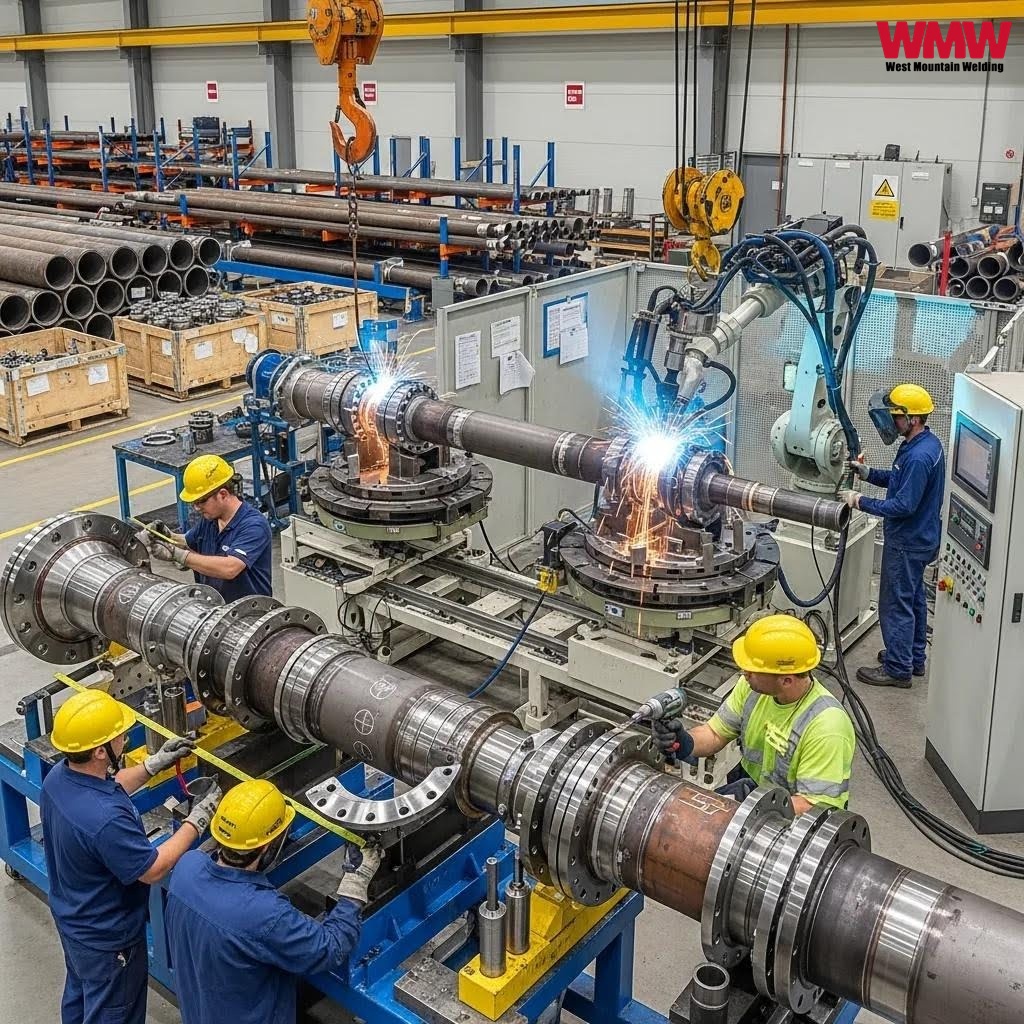
A fabricated pipe assembly is only as reliable as the standards it was built to. Governing standards for industrial prefabricated piping systems include:
ASME B31.3 — Process Piping: the primary code for chemical, petrochemical, and oil and gas process piping.
ASME B31.1 — Power Piping: governs steam and high-energy piping in power generation facilities.
ASME Section IX — Welding and Brazing Qualifications: establishes the qualification framework for welding procedures and welders.
API 570 — Piping Inspection Code: covers inspection, repair, and alteration of in-service piping systems.
ISO 9001 — Quality Management Systems: provides the framework for consistent, documented quality processes in fabrication shops.
CSA Z662 — Oil and Gas Pipeline Systems (Canada): governing standard for pipeline fabrication and installation in Canadian oil and gas applications.
Compliance with applicable standards is not optional; it is the baseline expectation for any industrial pipe fabrication work. West Mountain Welding maintains the documentation infrastructure to support third-party and owner audits on every project.
Emerging Technologies Advancing Pipe Prefabrication
The prefabricated pipe system sector is evolving rapidly, with several technologies improving both production efficiency and system performance:
3D Laser Scanning and Digital Metrology — Field conditions are scanned and converted to accurate 3D models before fabrication begins, eliminating the dimensional surprises that cause rework when spools arrive on-site.
CNC Pipe Cutting and Beveling — Computer-controlled cutting equipment produces consistent bevel geometry across high volumes of pipe cuts, improving fit-up quality and reducing hand-grinding time before welding.
Automated and Robotic Welding — Semi-automated orbital welding systems and robotic welding cells increase throughput and weld consistency on repetitive joint configurations in high-volume spool runs.
Digital Twin Integration — As-built spool data is fed back into the plant's digital model, creating a living record of actual installed geometry that supports maintenance planning and future modification work.
These technologies are not replacing skilled welders and fitters; they are extending the quality and throughput of what an experienced fabrication team can produce.
Sustainability Considerations in Modular Piping
Off-site fabrication inherently reduces the environmental footprint of industrial construction. Consolidating cutting, welding, and surface treatment into a single controlled facility reduces fuel consumption from on-site equipment, minimizes construction waste that ends up in landfill, and enables more efficient use of materials through better inventory management.
For projects with sustainability reporting requirements, including contractors working under ISO 14001 environmental management systems or projects seeking LEED credits, the documented waste reduction and energy efficiency benefits of modular piping systems provide measurable contributions to environmental targets.
Material selection also plays a role: duplex stainless and high-alloy piping systems that resist corrosion extend service life significantly over carbon steel in corrosive service, reducing replacement frequency and the embedded energy of future fabrication and installation.
Why Choose West Mountain Welding for Pipe Prefabrication
West Mountain Welding brings certified welders, documented quality systems, and practical fabrication experience to every prefabricated pipe system project. From single pipe spools to full modular piping skids, our shop produces assemblies built to code and engineered for long service life.
If you are planning a capital project, plant expansion, or facility upgrade that involves process piping, contact the team at West Mountain Welding to discuss your prefabrication requirements.
Frequently Asked Questions
1. What is the difference between a pipe spool and a prefabricated pipe system?
A pipe spool is a single pre-assembled piping section, a length of pipe with fittings, flanges, or valves, while a prefabricated pipe system is the complete set of spools and components engineered to make up an entire piping circuit or system.
2. How do prefabricated pipe systems reduce project costs?
They reduce on-site labour hours, cut material waste, improve schedule predictability, and minimize costly re-work by catching dimensional and quality issues in the shop before installation.
3. What industries use modular piping systems most commonly?
Oil and gas, water and wastewater treatment, chemical processing, power generation, and mining are the most frequent users of modular piping solutions.
4. What welding certifications should a pipe fabrication shop hold?
Look for welders qualified to ASME Section IX and shops operating under qualified Welding Procedure Specifications (WPS) with documented Procedure Qualification Records (PQRs).
5. Can prefabricated pipe systems be used for high-pressure or corrosive service?
Yes. Prefabrication is well-suited to demanding service conditions, controlled shop environments, and thorough pre-shipment inspection often produce higher-quality results than equivalent field-fabricated systems.