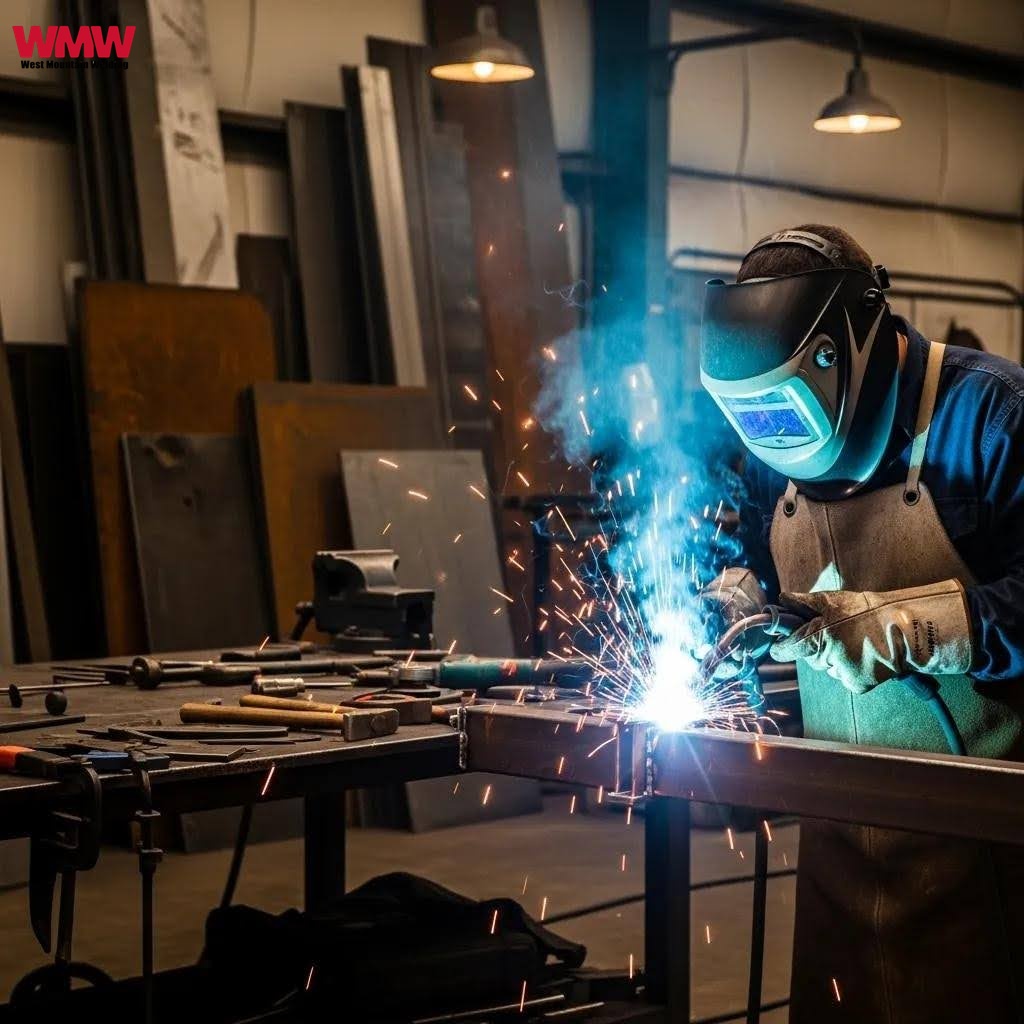
Industrial Metalwork in Utah for Critical Infrastructure Projects
Industrial metalwork in Utah is the backbone of the state's most demanding construction and maintenance efforts. From high-voltage substations along the Wasatch Front to pipeline systems crossing remote terrain, structural steel fabrication in Utah and precision welding services make it possible to build, maintain, and upgrade infrastructure that communities rely on every day.
At West Mountain Welding, our certified welders and fabricators bring hands-on regional expertise to every critical infrastructure project, large or small.
What Is Industrial Metalwork and Why Does It Matter in Utah?
Industrial metalwork encompasses the cutting, forming, joining, and finishing of metal components used in permanent or load-bearing structures.
In Utah's energy, transportation, water, and utility sectors, these components must perform reliably under desert heat, freeze-thaw cycles, and seismic loads. Infrastructure welding in Utah, therefore, demands more than raw skill; it requires certified procedures, documented quality control, and a thorough understanding of applicable codes.
West Mountain Welding has built its reputation on exactly that combination. Our work supports utility-scale energy installations, municipal water infrastructure, transportation corridor expansions, and industrial facility upgrades across the state.
Core Welding Techniques Used in Critical Infrastructure Projects
Selecting the right process is the first decision in any structural steel fabrication project. Each method carries distinct strengths for specific material thicknesses, positions, and site conditions.
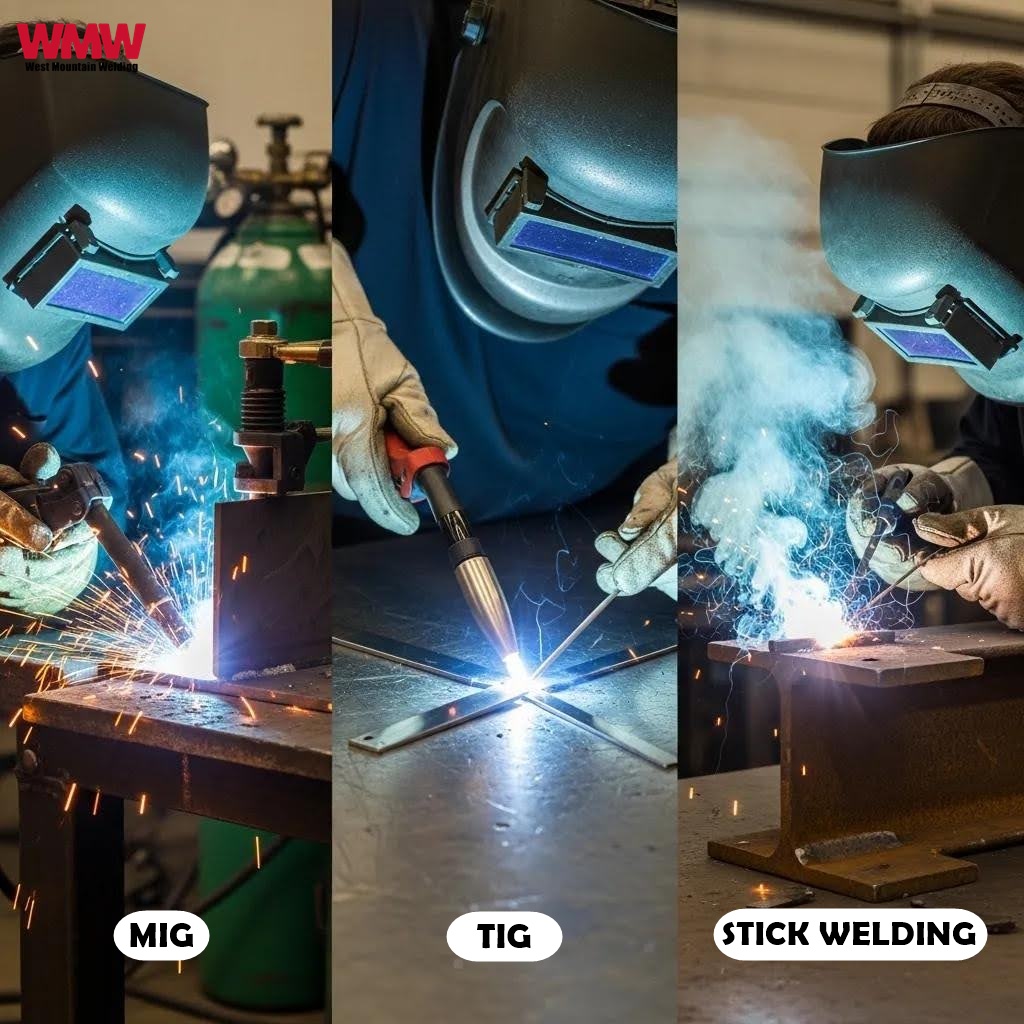
1. MIG (Metal Inert Gas) Welding
Uses a continuously fed wire electrode to fuse metals quickly and consistently. Its high deposition rate makes it a standard choice for thicker structural sections, fabricated steel assemblies, and production shop work where throughput matters.
2. TIG (Tungsten Inert Gas) Welding
Relies on a non-consumable tungsten electrode and offers exceptional arc control. It is preferred for thin-wall tubing, stainless components, and precision applications where weld quality and visual appearance are subject to strict inspection, including certain aerospace and instrumentation tie-ins.
3. Stick Welding (SMAW)
Remains indispensable for field work. Its portability and tolerance for surface conditions make it the go-to process for remote pipeline welding, structural repairs, and outdoor installations where shielding gas is impractical.
4. CNC Plasma Cutting
Uses a computer-controlled, high-velocity ionized gas jet to cut steel plate and structural shapes to tight tolerances. Complex profiles, connection plates, and repetitive part geometries are produced accurately and efficiently, reducing downstream fit-up time.
5. Robotic Welding
Brings automation to high-volume fabrication runs. Consistent travel speed, arc parameters, and torch positioning reduce variability, improve dimensional control, and accelerate throughput on repeat assemblies.
Applications: Where Industrial Metalwork Supports Utah's Infrastructure
Critical infrastructure Utah projects span multiple sectors, each placing unique demands on materials, joint design, and inspection requirements.
Substation and Switchyard Fabrication
Electrical infrastructure construction requires steel structural members, equipment pads, bus support structures, and grounding assemblies fabricated and installed to utility specifications. Precision fit-up and certified weld procedures are non-negotiable when live grid assets are nearby.
Oil and Gas Pipeline Welding
Pipeline integrity depends on root-pass quality, full-penetration joints, and radiographic or ultrasonic verification. Our welders hold qualifications for carbon steel and alloy pipe welding in accordance with API and ASME standards, supporting both transmission and distribution systems across Utah's energy corridors.
Power Plant Maintenance Welding
Scheduled outage windows leave little room for delay. Our crews perform pressure vessel repairs, structural reinforcement, equipment mounting, and heat exchanger work to keep generation assets online and compliant.
Transportation Infrastructure Steel Work
Bridge components, overhead sign structures, retaining wall hardware, and rail-related fabrications all fall within the scope of structural steel fabrication in Utah. West Mountain Welding produces these components to the AASHTO and AWS D1.5 bridge welding code requirements when specified.
Water and Wastewater Infrastructure
Pump station frames, tank appurtenances, pipe supports, and custom hardware for treatment facilities require corrosion-resistant alloys and coatings selected for long service life in wet environments.
Industry Standards and Certifications That Govern Quality
Compliance with industry codes is not optional in infrastructure welding in Utah; it is the foundation of every deliverable.
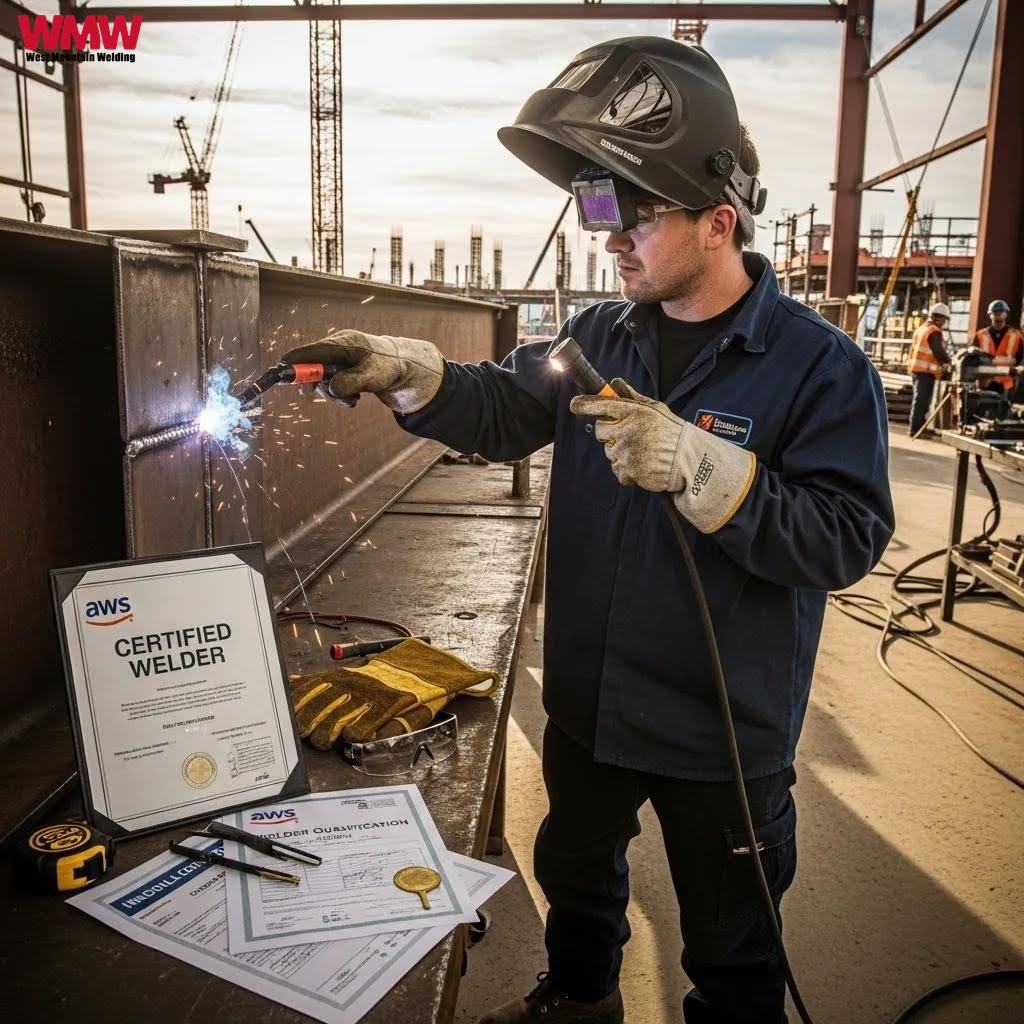
AWS D1.1 – Structural Welding Code (Steel) governs the fabrication and erection of structural steel components. Welders qualified under D1.1 demonstrate tested proficiency in specific joint configurations, positions, and material groups. For clients, AWS D1.1 certification from the welder and the fabricating organization translates directly into documented traceability, reduced rework risk, and confident third-party inspection outcomes.
ASME Section IX establishes welder and welding procedure qualification requirements for pressure vessels and piping systems. Projects involving boilers, pressure piping, and heat exchangers require ASME-compliant procedure qualification records (PQRs) and welder performance qualifications (WPQs).
OSHA 1910 and 1926 Standards mandate hazard controls, personal protective equipment, confined space procedures, and hot work permitting for welding operations. West Mountain Welding maintains a robust safety program aligned with these requirements, protecting both our personnel and client site workers on every project.
API 1104 applies to pipeline welding and specifies the qualification of welding procedures and welders for field girth and repair welds on liquid and gas transmission lines.
Maintaining current certifications across these standards requires continuous investment in training, documentation, and internal auditing, all of which West Mountain Welding treats as core operational functions rather than occasional checkboxes.
Precision, Quality Control, and Project Execution
Large-scale structural steel fabrication in Utah depends on systematic quality control from the first cut to final inspection.
Our shop fabrication process begins with verified material certifications (mill test reports), continues through dimensional inspection at intermediate stages, and concludes with visual and, where required, non-destructive examination (NDE) of completed welds. NDE methods, including magnetic particle testing (MT), liquid penetrant testing (PT), and ultrasonic testing (UT), are applied per project specifications and code requirements.
Project management practices reinforce technical quality. Defined fabrication schedules, prefabrication of assemblies where access permits, and clear communication protocols between our team and client site supervisors allow West Mountain Welding to meet aggressive timelines without compromising weld integrity. Emergency response capability, including mobilization for unplanned outages and field repairs, means clients have a reliable partner when unscheduled needs arise.
Code compliance is maintained through documented welding procedure specifications (WPSs), welder qualification records kept current, and internal quality audits. When third-party inspectors or owner engineers conduct hold-point inspections, our documentation is ready.
How Automated Welding Technology Is Advancing Fabrication in Utah
Robotic welding cells and CNC fabrication equipment are reshaping what is achievable in industrial metalwork in Utah. Automation does not replace the skilled welder; it handles high-repetition tasks with consistent parameters, freeing certified welders to focus on complex joints, critical weld positions, and field work that requires adaptability.
For clients, the practical benefits include tighter dimensional tolerances on fabricated assemblies, reduced heat input variability, and shorter lead times on repeat-geometry components. CNC plasma and oxy-fuel cutting systems provide the same advantages for plate work.
As Utah's infrastructure investment grows, fabricators who integrate automation alongside certified manual welding capabilities are positioned to deliver both quality and volume.
West Mountain Welding: Serving Utah's Critical Infrastructure Needs
West Mountain Welding is a Utah-based industrial metalwork and welding contractor with direct experience supporting energy, utility, transportation, and industrial clients across the state. Our differentiators are straightforward: local knowledge of Utah's terrain and regulatory environment, certified welders qualified across multiple processes and codes, in-house CNC fabrication capability, and a demonstrated track record of on-time delivery.
We offer shop and field fabrication, emergency repair response, prefabricated structural and utility assemblies, and full documentation packages including WPSs, WPQs, and material certifications. Whether a project requires pipeline welding on a remote right-of-way or precision shop fabrication for a substation expansion, West Mountain Welding brings the right qualifications and equipment to the work.
Regional Market Trends Driving Demand for Industrial Metalwork in Utah
Utah's population growth, federal infrastructure investment, and ongoing energy transition are generating sustained demand for structural steel fabrication and infrastructure welding services. Transportation corridor expansions, grid modernization projects, water system upgrades, and industrial facility construction are all contributing to a pipeline of work that rewards fabricators with documented quality systems and certified personnel.
The shift toward renewable energy generation, solar farms, wind installations, and battery storage facilities introduces new structural steel and specialty metal fabrication requirements.
Simultaneously, aging fossil-fuel and water infrastructure requires ongoing maintenance welding that demands the same certifications as new construction. Contractors who can serve both new-build and maintenance markets are well-positioned as Utah's infrastructure investment cycle continues.
Frequently Asked Questions
1. What certifications should an industrial metalwork contractor in Utah hold?
Look for AWS D1.1 (structural steel), ASME Section IX (pressure vessels and piping), and API 1104 (pipeline welding) qualifications, along with documented OSHA safety compliance.
2. What is the difference between MIG and TIG welding for infrastructure projects?
MIG is faster and suited to thicker structural steel; TIG provides finer control for thin-wall or precision components where weld quality and appearance are closely inspected.
3. How does West Mountain Welding support emergency infrastructure repairs in Utah?
We maintain field-ready crews and equipment for rapid mobilization, supporting unplanned outages, pipeline repairs, and critical structural fixes with minimal downtime.
4. What quality documentation should clients expect from a structural steel fabricator?
Clients should receive welding procedure specifications (WPSs), welder performance qualification records (WPQs), mill test reports, and NDE inspection reports where required by code or specification.
5. Why does AWS D1.1 certification matter for critical infrastructure projects?
AWS D1.1 verifies that welders and procedures meet tested quality benchmarks for structural steel, which satisfies engineer-of-record requirements, supports third-party inspection, and reduces the risk of costly weld failures.