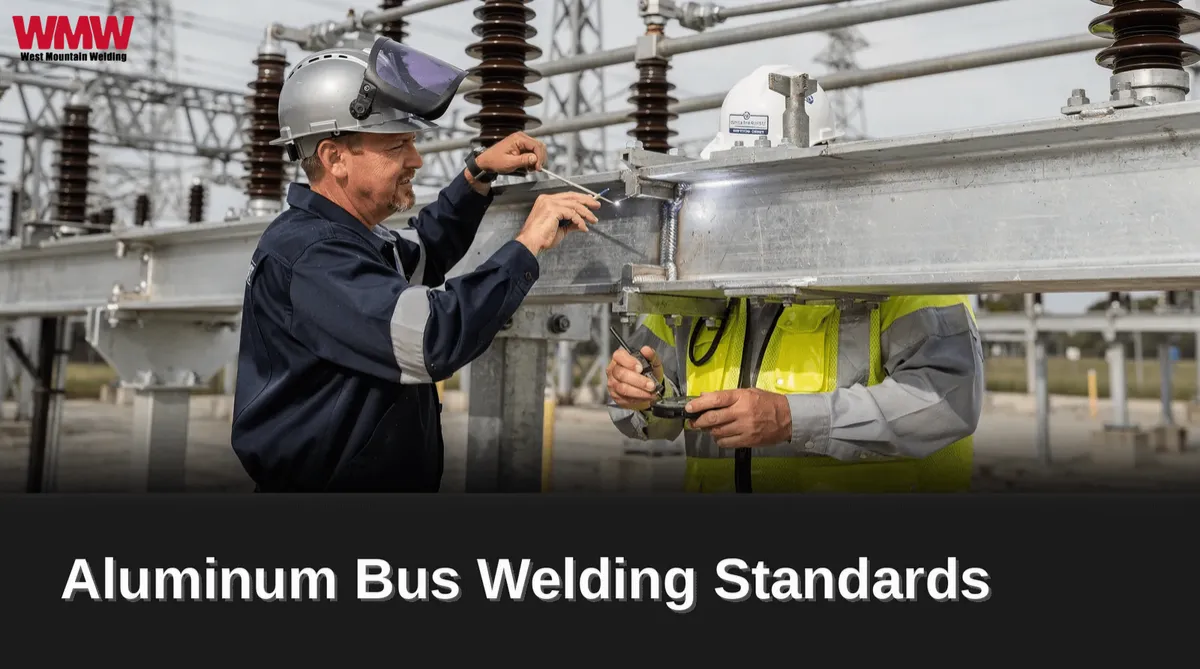
Aluminum Bus Welding for Substations: AWS D1.2 Requirements Explained
Aluminum bus welding for substations follows AWS D1.2, the Structural Welding Code–Aluminum, which sets requirements for qualified procedures, qualified welders, joint preparation, and inspection. The 2026 edition is the current version. The code protects structural integrity, but low-resistance joints also depend on preparation and verification steps the project specification must add.
Key Takeaways
AWS D1.2 governs procedure qualification, welder qualification, fabrication, and inspection for structural aluminum, and the 2026 edition replaces the 2014 edition.
The code is a structural document. Electrical acceptance, such as micro-ohm resistance limits, usually comes from the owner's specification.
Qualification test positions and joint configurations should match the field joints actually being welded.
Oxide removal, controlled fit-up, and a draft-free weld zone prevent most resistance hotspots.
That distinction drives every decision in substation aluminum bus welding. This guide is written for project managers, EPC teams, utility engineers, and QA/QC inspectors who specify or accept tubular aluminum bus welding across Utah and the Mountain West. It explains what AWS D1.2 requires, where the code stops, and what field crews do to keep switchyard bus welding joints cool under load.
What AWS D1.2 Covers in Aluminum Bus Welding
The American Welding Society publishes D1.2 for structures built from aluminum structural alloys. According to AWS, the 2026 edition is the first update since 2014, supersedes that edition, and reflects advances in materials, welding technology, qualification requirements, and fabrication practices.
Three practical points deserve plain statement:
D1.2 applies by contract, not by default. It governs a job only when the contract documents name it, so the edition year belongs in the specification.
D1.2 is not a conductivity standard. It qualifies the procedure, the welder, and the weld quality. It does not set how little resistance a bus joint must have.
Some owners cite other documents. Bus conductor manufacturers such as AFL point to the Aluminum Association's Aluminum Construction Manual for qualification, so confirm which document your project names.
Earlier editions of D1.2 also carve out pressure vessels and fluid-carrying pipelines. Bus pipe is an electrical conductor, not a pressure pipeline, but the scope clause is worth reading against your contract language.
Qualifying Procedures and Welders for Substation Aluminum Bus Welding
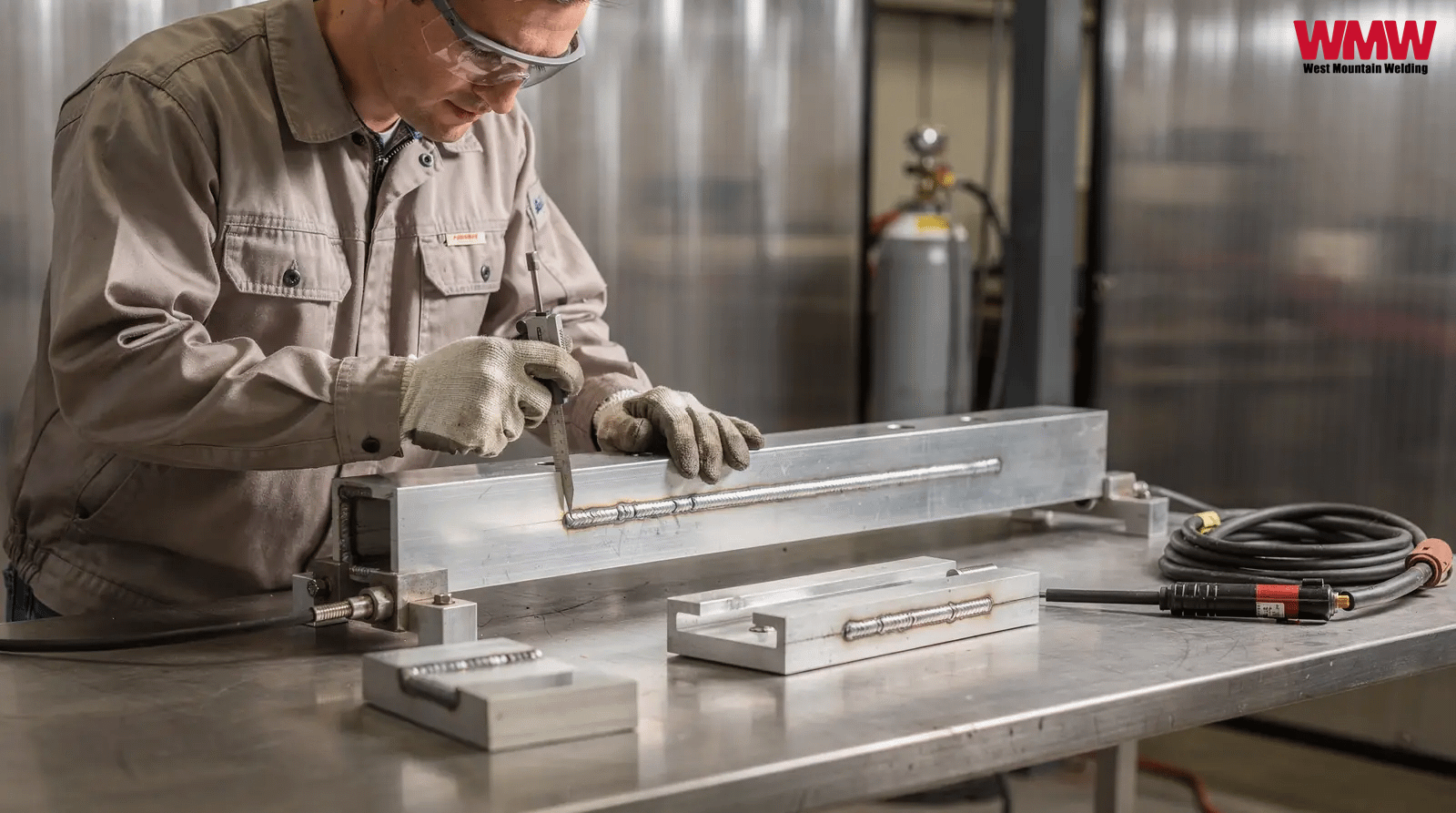
Code-compliant work starts on paper. Three documents form the package, and inspectors expect to see all of them before production welding begins:
Welding procedure specification (WPS): the written instructions covering base alloy, filler alloy, process, joint design, shielding gas, and heat controls.
Procedure qualification record (PQR): the test evidence proving the WPS produces sound welds.
Welder performance qualification (WPQ): proof that each welder passed testing on a joint comparable to production.
Essential variables cannot change without requalification. Swapping filler alloy, shifting to a different base alloy group, or changing the process each triggers a new look at the qualification.
Welder qualification deserves the same discipline. A qualification earned on one joint type does not automatically carry to another, and rigid bus is often welded in place at height. A flat-position coupon does not prove a welder can run an overhead joint on a 6-inch tube. Qualification also lapses when a welder goes six months without using the process, so continuity logs matter as much as the original test.
The practical advice: request the WPS, PQR, and welder continuity records during submittals, not at the first inspection. Missing paperwork found after the crew mobilizes costs schedule days that no one can recover.
Joint Preparation That Prevents Resistance Hotspots in Tubular Aluminum Bus Welding
Resistance hotspots start at the joint surface. Aluminum forms an oxide layer almost instantly, and that oxide melts at roughly 3,700°F while the base metal melts near 1,220°F. If the oxide is not removed, the arc fights it, inclusions form, and those inclusions become resistance points under load current.
Moisture and hydrocarbons cause the same trouble. AFL's welding specification for tubular bus calls for joints free of moisture and hydrocarbons, solvent degreasing, and stainless steel wire brushing after the solvent to remove oxide films. Shop crews turn that guidance into a repeatable sequence:
Cut the tube square and burr-free to the specified length.
Machine the bevel to the angle and land dimension in the WPS.
Degrease with an approved solvent and let it fully evaporate.
Remove oxide with a stainless steel brush reserved for aluminum only.
Check fit-up gap and alignment against procedure tolerance, then tack.
Weld soon after cleaning, because oxide returns within hours.
Heat Input, HAZ, and Shielding Gas in Aluminum Bus Pipe Welding
Aluminum conducts heat quickly, so heat input is a balancing act. Too little causes lack of fusion at the root. Too much widens the heat-affected zone (HAZ), where heat-treatable alloys such as 6061-T6 lose a significant share of their strength. Tubular bus is commonly 6061 or 6063, so HAZ management is a mechanical concern as well as an electrical one.
Both gas tungsten arc welding (GTAW) and gas metal arc welding (GMAW) are used on bus. AFL's specification lists AC for TIG and reverse-polarity DC for MIG, welding-grade argon, helium, or a blend as shielding gas, and 4043 filler. Your WPS may call for 5356 or another alloy, so follow the qualified document.
Heat control comes down to habits:
Set amperage for wall thickness and joint type before striking the arc.
Hold a consistent travel speed for a uniform bead without undercut.
Check interpass temperature with a contact thermometer between passes.
Check each pass before laying the next, as AFL recommends for multipass welds.
Direct the arc toward the heavier section on thin edges.
Pure argon gives the steadiest arc in most field conditions. Helium blends add heat for thick walls but need higher flow rates outdoors. Wind is the real enemy of shielding. Gas coverage degrades above roughly 5 mph, so windscreens or a weld tent are standard equipment for outdoor switchyard bus welding.
Inspection and Micro-Ohm Verification for Switchyard Bus Welding
Visual examination is the baseline for every completed weld. Radiographic or liquid penetrant testing follows where joint geometry, service conditions, or the contract's inspection plan call for deeper verification. These methods target incomplete fusion, porosity, and crater cracks, which grow under thermal cycling.
Bus joints must also conduct, not just hold. Many owners add electrical verification, typically micro-ohm testing across the joint compared against an equal length of parent conductor, and some schedule infrared thermography once the bus carries load. D1.2 does not prescribe those checks, so the project specification must.
A defensible inspection sequence looks like this:
Verify welder qualifications against the governing procedure.
Inspect every weld visually.
Run volumetric NDE at the sampling rate in the inspection plan.
Measure joint resistance where the owner requires it.
Document findings and close every nonconformance before release.
Specification Checklist for Engineers and EPC Teams
Before bid, confirm these items are written into the documents:
The D1.2 edition year, stated explicitly.
The submittal deadline for WPS, PQR, and welder records.
Qualification positions that match field joints.
The NDE method and sampling percentage.
Any electrical acceptance criteria, including the resistance ratio and who witnesses testing.
Field Lessons That Reduce Rework
Outdoor conditions erase the controls a shop provides, so crews plan for them. Humidity and morning condensation put moisture on prepared surfaces, so joints are cleaned and welded the same shift. Thermal expansion shifts long tubular runs between tacking and welding, so alignment is rechecked before each pass. Filler wire stays sealed until needed, because contaminated or damp wire produces porosity that radiography will find later.
Working With a Crew That Knows Switchyard Work
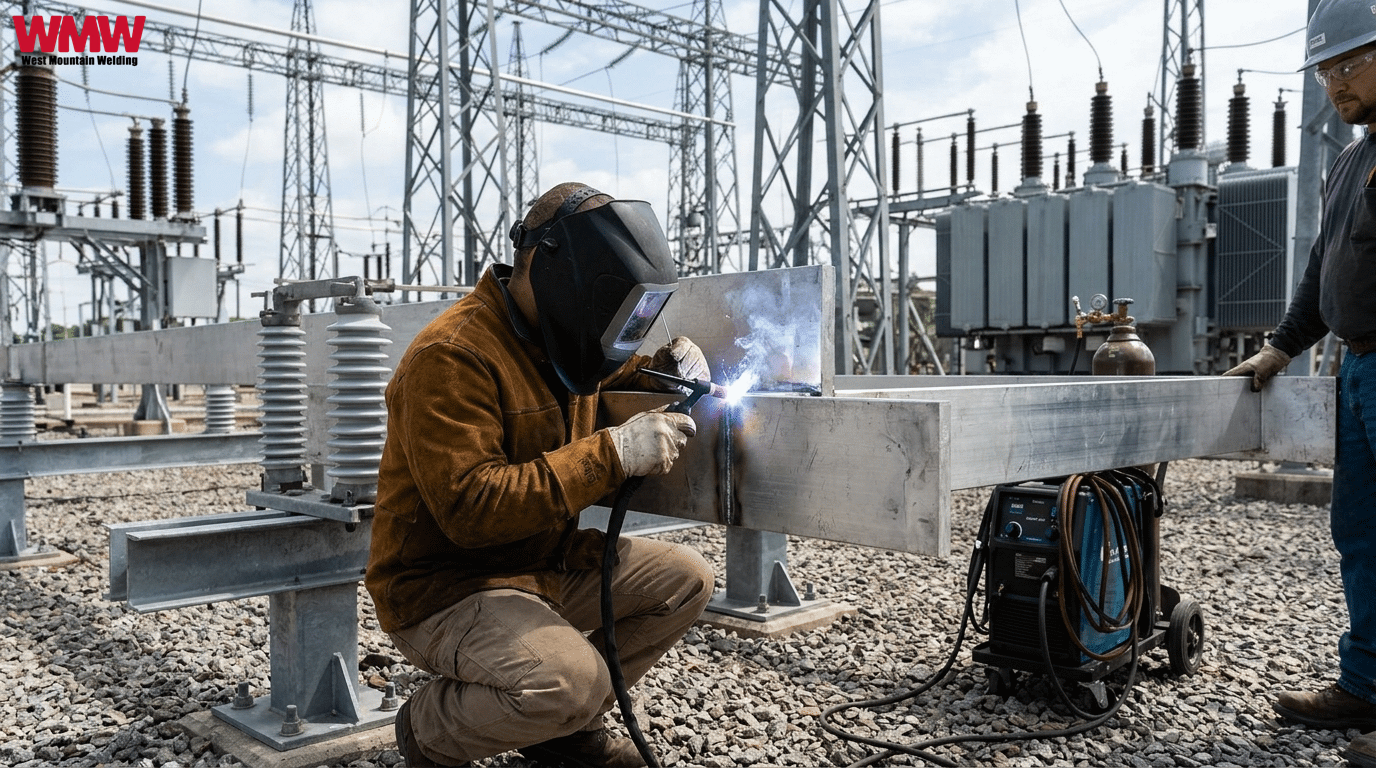
West Mountain Welding supports utility and power projects with certified welders working to AWS D1.2, and procedures and qualifications are available on request. For related reading, see our guides on pipe welding inspection checklists and custom industrial fabrication.
Conclusion
Aluminum bus welding to AWS D1.2 comes down to qualified procedures, disciplined joint preparation, controlled heat input, and verified inspection. The code sets the baseline, and the project specification closes the electrical gap the code leaves open. Specify the edition, demand the paperwork early, and verify resistance as well as weld quality, and the bus energizes cleanly and stays online.
FAQ
What does AWS D1.2 cover for aluminum bus welding?
AWS D1.2 covers procedure qualification, welder qualification, fabrication, and inspection for welded structural aluminum. Contracts for substation aluminum bus welding often cite it as the quality baseline.
Is AWS D1.2 required for substation aluminum bus welding?
It is required when the contract or owner specification names it. Always confirm the edition year, which is currently 2026.
What is the best shielding gas for tubular aluminum bus welding?
Pure argon is the most common choice for arc stability in the field. Argon-helium blends add heat on thicker walls but need higher flow rates.
How long does a welder's D1.2 qualification last?
A qualification generally remains valid while the welder keeps using the process, and it lapses after six months without it.
How is aluminum bus pipe welding inspected?
Every weld gets visual examination, with radiographic or penetrant testing on a sampling plan. Many owners also require micro-ohm resistance checks.