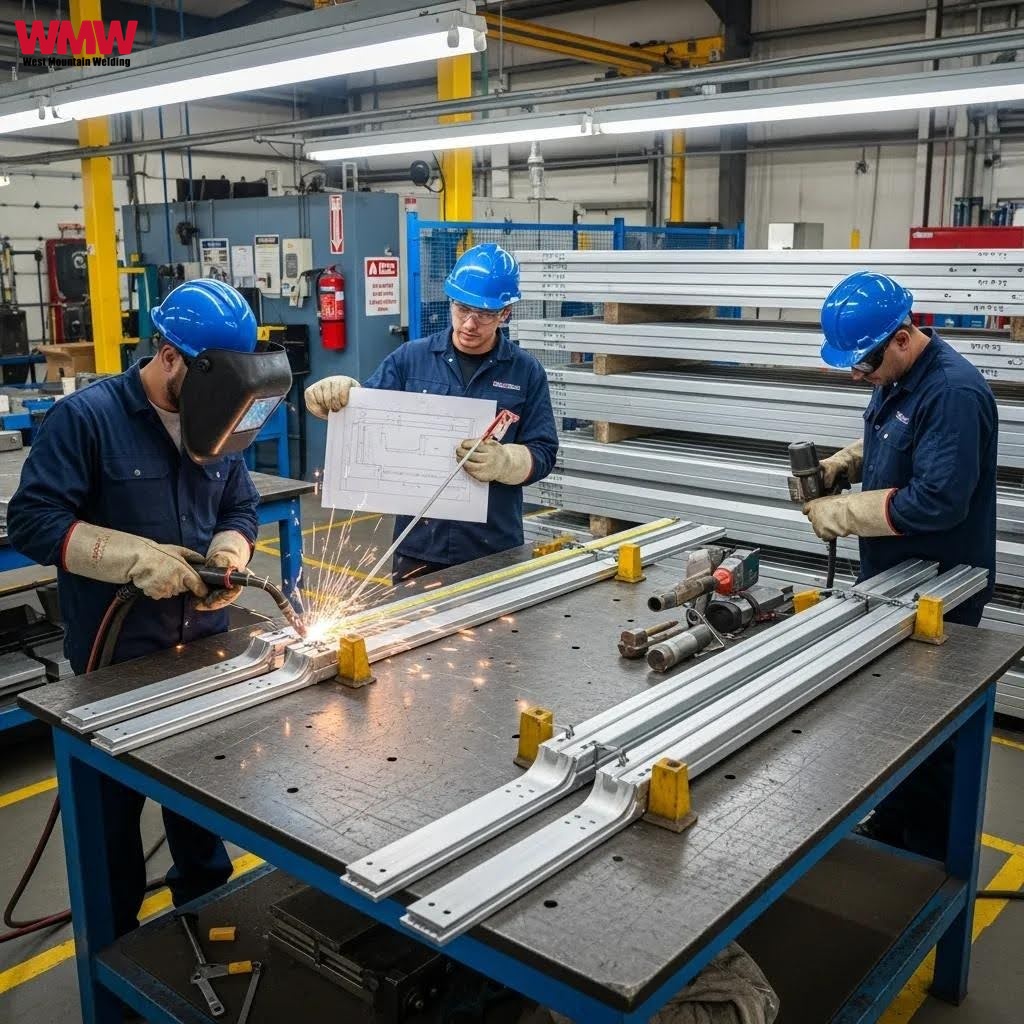
Aluminum Bus Bar Guide for Modern Industrial Power System Use
Aluminum bus bars are foundational components in modern industrial power systems, delivering reliable electrical conductivity, mechanical durability, and long-term cost efficiency. Whether you are designing a new switchgear assembly, upgrading a distribution panel, or evaluating aluminum bus bar vs copper alternatives, this guide covers what you need to know, from material properties and fabrication standards to certified welding techniques and maintenance best practices.
At West Mountain Welding, our certified fabricators and welders specialize in precision aluminum bus bar manufacturing for industrial, utility, and commercial power applications. Here is our expert breakdown.
What Is an Aluminum Bus Bar?
An aluminum bus bar is a rigid, flat or rectangular conductor made from aluminum alloy, most commonly 1350-H19 or 6101-T61, used to carry large amounts of electrical current within power distribution systems. Bus bars serve as centralized electrical junctions, connecting multiple circuits to a common supply point inside switchboards, panelboards, substations, and motor control centers.
Unlike individual wire runs, aluminum bus bars offer a low-impedance, high-current pathway that reduces voltage drop and simplifies system layout. They are rated by ampacity, cross-sectional area, and alloy grade to match specific load requirements.
Common industrial applications include:
High-voltage switchgear and circuit breaker panels
Generator output connections
Transformer secondary terminals
Industrial motor control centers (MCCs)
Data center power distribution units (PDUs)
Renewable energy inverter connections
Key Material Properties of Aluminum Bus Bars
Understanding aluminum's properties helps engineers and contractors select the right conductor for each application.
Electrical conductivity: Aluminum has approximately 61% of the electrical conductivity of copper (IACS). However, because aluminum is significantly lighter, a larger cross-section can be used without approaching the weight penalty of an equivalent copper conductor, making it practical for high-ampacity runs.
Weight-to-strength ratio: Aluminum bus bars weigh roughly one-third as much as copper equivalents. This reduces structural load on enclosures and support hardware, simplifies handling during installation, and lowers shipping costs on large projects.
Corrosion resistance: Aluminum naturally forms an oxide layer that protects the base metal in most industrial atmospheres. In aggressive environments such as coastal or chemically active facilities, anodizing or protective coating can be specified.
Thermal expansion: Aluminum expands and contracts at a higher rate than copper. Proper joint design, expansion loops, and appropriate hardware torque specifications are essential to maintain reliable connections over thermal cycles.
Alloy selection: Alloy 1350-H19 is preferred for maximum conductivity in overhead and bus bar applications. Alloy 6101-T61 provides higher mechanical strength where structural demands are elevated, such as in exposed or cantilevered configurations.
Aluminum Bus Bar vs Copper: Which Is Right for Your Project?
The aluminum bus bar vs copper comparison is one of the most common decisions in power system design. Both materials are viable; the right choice depends on project-specific constraints.
Electrical Performance
Copper outperforms aluminum in raw conductivity, but aluminum bus bars can be sized to deliver equivalent ampacity at a fraction of the material cost. For most industrial distribution applications operating at 600 V or below, aluminum provides sufficient performance when properly sized per NEC or applicable standards.
Cost Advantage
Aluminum typically costs 40–60% less per pound than copper, and its lower density means less material is required by weight to achieve a given current capacity. On large-scale projects, such as substations, industrial plants, and data centers, this difference translates to significant savings on material procurement.
Weight and Installation
Aluminum's lighter weight reduces structural support requirements and makes field handling easier, particularly for long bus bar runs. Electricians and ironworkers report fewer ergonomic challenges when positioning aluminum than when working with heavy copper assemblies.
Maintenance Considerations
Aluminum requires attention at connection points. An oxide film can increase contact resistance at bolted joints if the surfaces are not properly prepared. Using appropriate joint compound (NO-OX-ID or equivalent), stainless steel or aluminum-compatible hardware, and correct torque values mitigates this issue. Copper connections are generally less sensitive to this effect.
Summary Comparison
Aluminum Bus Bar vs. Copper Bus Bar
Conductivity (% IACS):
Aluminum: ~61%
Copper: ~100%
Relative Weight:
Aluminum: About one-third the weight of copper
Copper: Baseline
Material Cost:
Aluminum: Lower
Copper: Higher
Corrosion Resistance:
Aluminum: Good (with proper preparation)
Copper: Excellent
Weldability:
Aluminum: Requires a certified process
Copper: Easier to weld
NEC Sizing Adjustment:
Aluminum: Required (needs a larger cross-section)
Copper: Baseline
Expert Fabrication Techniques for Aluminum Bus Bars
Precision fabrication is the foundation of a reliable aluminum bus bar assembly. Dimensional accuracy affects both electrical performance and mechanical fit within enclosures and support structures.
Cutting and Shaping
Aluminum bus bars are cut to length using cold saws, band saws, or CNC shearing equipment. Punching or drilling creates bolt holes and mounting points. Bending for offsets, 90-degree turns, or custom configurations is performed on hydraulic or manual bus bar benders calibrated to maintain a consistent bend radius without cracking the alloy.
Surface Preparation
Before welding or bolting, all mating surfaces must be cleaned of oxide film and contamination. Wire brushing with a stainless steel brush (dedicated to aluminum only), solvent wiping, or mechanical abrasion prepares surfaces for reliable contact. This step is non-negotiable for both welded joints and bolted connections.
Custom Fabrication
Custom aluminum bus bar fabrication allows project teams to receive pre-formed, pre-drilled, and pre-labeled assemblies ready for direct installation. This reduces onsite labor, limits measurement errors, and supports just-in-time delivery on compressed schedules. West Mountain Welding provides custom fabrication services sized to your project's single-line drawings and enclosure layouts.
Fixturing and Alignment
During assembly, secure fixturing holds bus bars in correct alignment before and during welding. Misalignment introduces stress concentrations and can compromise joint quality. Proper fixturing also prevents warping during thermal cycles inherent to welding.
Aluminum Bus Bar Welding Solutions
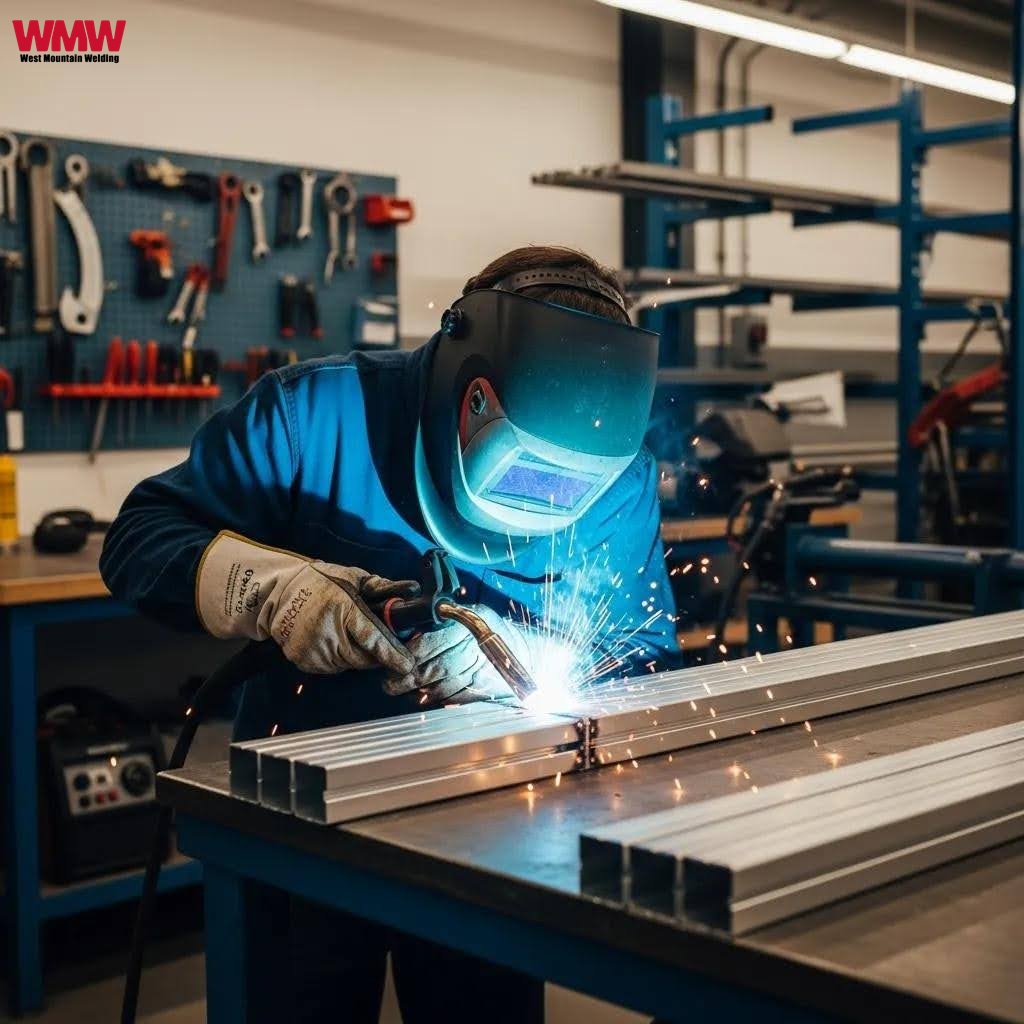
Welded joints in aluminum bus bar assemblies must achieve full fusion, correct penetration, and freedom from porosity or cracking. West Mountain Welding's certified welders apply proven methods to meet these requirements consistently.
MIG Welding (GMAW)
Gas Metal Arc Welding (MIG/GMAW) is widely used for aluminum bus bar fabrication due to its higher deposition rate and suitability for thicker cross-sections. Using 4043 or 5356 filler wire with a 100% argon shielding gas, MIG welding provides good fusion with controlled heat input when parameters are properly set. Spool gun or push-pull gun configurations prevent wire feeding issues common with aluminum.
TIG Welding (GTAW)
Gas Tungsten Arc Welding (TIG/GTAW) delivers the highest weld quality for aluminum, offering precise control of the heat-affected zone and weld profile. TIG is preferred for critical connections, thin-gauge bus bars, and joints requiring X-ray or dye-penetrant inspection. AC mode with a thoriated or zirconiated tungsten electrode and pure argon shielding produces the clean, oxide-free welds required for electrical conductors.
Stick Welding (SMAW)
Shielded Metal Arc Welding is less common for aluminum bus bars but applicable in field repair scenarios where shielding gas is unavailable. Specialized aluminum electrodes are required. Weld quality is generally lower than MIG or TIG and is not preferred for primary fabrication.
Robotic and Automated Welding
For high-volume or repetitive bus bar configurations, automated MIG or TIG systems improve consistency, reduce operator variability, and increase throughput. Robotic cells maintain identical parameters across every weld, supporting tighter quality control documentation.
Non-Destructive Testing (NDT)
After welding, NDT methods verify joint integrity without damaging the component. Common methods for aluminum bus bar welds include:
Visual inspection (VT): First-pass check for surface defects, incomplete fusion, and geometric conformance
Dye penetrant inspection (PT): Detects surface-breaking cracks and porosity
Radiographic testing (RT): Reveals subsurface porosity and incomplete penetration in critical joints
Welding Standards and Compliance Requirements
Compliance with recognized industry standards is not optional; it is the baseline for safe, insurable, and code-compliant aluminum bus bar fabrication.
AWS D1.2 — Structural Welding Code: Aluminum
AWS D1.2 is the primary standard governing aluminum welding in structural and fabrication applications. It specifies acceptable welding procedures, welder qualification requirements, joint design, preheat conditions, and inspection criteria. All aluminum bus bar welding performed at West Mountain Welding is conducted in accordance with AWS D1.2.
AWS B2.1 — Welding Procedure and Performance Qualification
AWS B2.1 establishes the framework for qualifying welding procedure specifications (WPS) and welder performance qualification records (WPQR). Qualified procedures document the essential variables base metal, filler metal, shielding gas, travel speed, and amperage that must be controlled to reproduce acceptable welds.
ASME Section IX
For pressure-boundary or ASME-governed applications, Section IX of the ASME Boiler and Pressure Vessel Code provides qualification standards for welding procedures and welders. While aluminum bus bars are typically outside the pressure vessel scope, some utility and industrial facilities require ASME-qualified welders for all structural work on-site.
NEC and Utility Requirements
The National Electrical Code (NEC), specifically Article 366 (Busways) and Article 408 (Switchboards, Switchgear, and Panelboards), governs the installation and sizing of bus bar assemblies in the United States. Utility-specific interconnection standards may impose additional requirements for metering points and service entrance conductors.
Best Practices for Installation and Maintenance
Installation
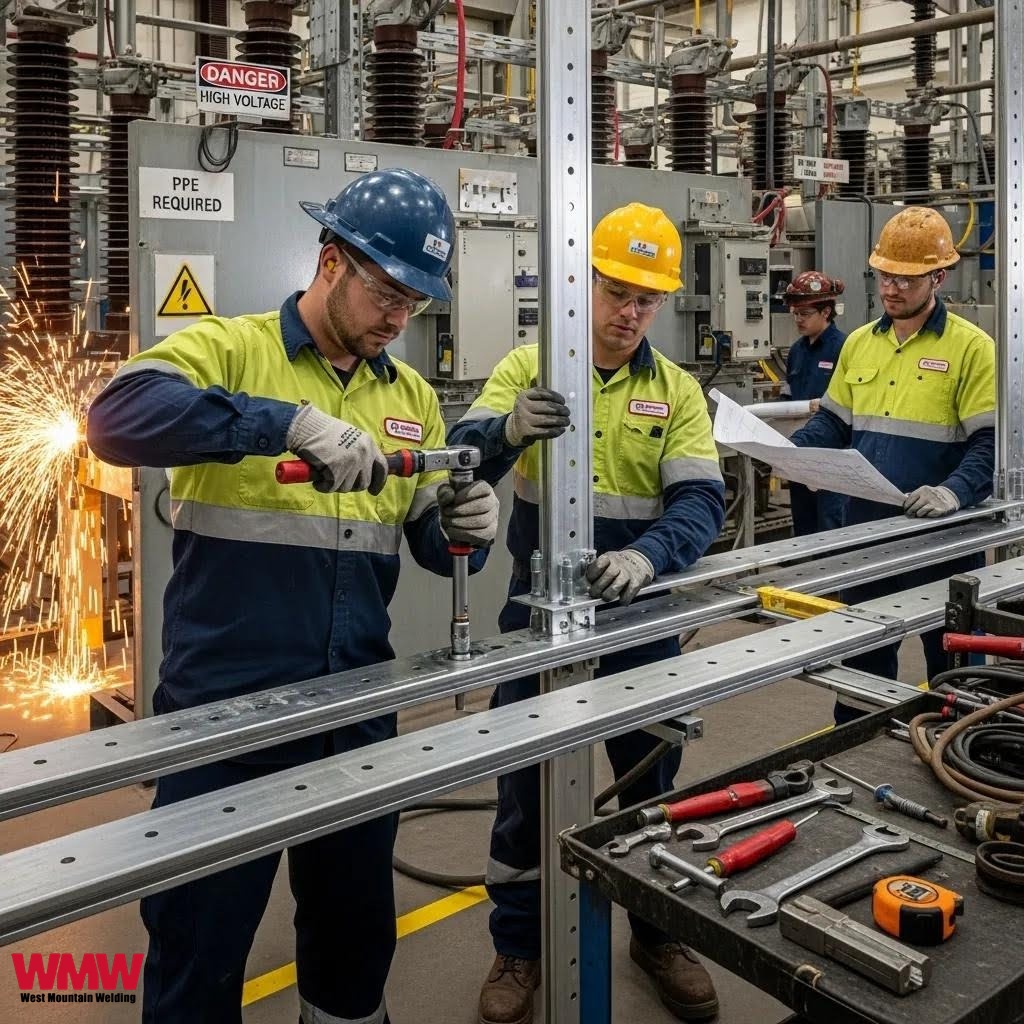
Correct installation protects the investment in quality fabrication. Key practices include:
Joint preparation: Clean all contact surfaces immediately before assembly. Apply approved joint compound to bolted aluminum connections.
Hardware selection: Use silicon bronze, stainless steel, or aluminum-compatible bolts and washers. Avoid plain steel hardware that can corrode and seize.
Torque specification: Follow the manufacturer or NEC Annex I torque values for all bolted connections. Under-torquing causes high-resistance hot spots; over-torquing can crack bus bar material.
Thermal expansion allowance: Install expansion fittings or loops on runs exceeding manufacturers' recommended spans to accommodate thermal movement.
Support spacing: Follow NEC and manufacturer guidelines for support interval to prevent sag and vibration-induced fatigue.
Trade coordination: Schedule bus bar installation to avoid conflicts with conduit, mechanical, and structural work. Coordinate with the GC and other subs early.
Maintenance
Scheduled maintenance extends service life and prevents unplanned outages.
Infrared thermography: Annual IR scans identify hot spots at connections before failure occurs. Elevated temperature at a joint indicates increasing contact resistance requiring corrective action.
Torque verification: Periodically re-torque bolted connections, particularly after the first full thermal cycle of a new installation.
Visual inspection: Inspect for discoloration, corrosion, physical damage, and loose hardware during scheduled shutdowns.
Contact surface cleaning: Where connections are opened for maintenance, re-clean surfaces and apply fresh joint compound before reassembly.
Why Choose West Mountain Welding for Aluminum Bus Bar Fabrication?
West Mountain Welding brings certified welding expertise, AWS-compliant procedures, and custom fabrication capability to every aluminum bus bar project. Our team works directly with electrical contractors, engineers, and plant maintenance teams to deliver bus bar assemblies that meet your specifications; cut, shaped, drilled, and welded to print.
From single custom assemblies to high-volume production runs, we apply the same rigorous standards to every project. Contact West Mountain Welding to discuss your aluminum bus bar fabrication requirements and request a quote.
Get in Touch with West Mountain Welding →
Frequently Asked Questions About Aluminum Bus Bars
1. What is an aluminum bus bar used for?
An aluminum bus bar is used to distribute large electrical current among multiple circuits within switchgear, panelboards, substations, and motor control centers.
2. How does an aluminum bus bar compare to copper in terms of conductivity?
Aluminum has roughly 61% of copper's conductivity, but can be sized larger to carry equivalent current at significantly lower material cost and weight.
3. What welding standard applies to aluminum bus bar fabrication?
AWS D1.2 (Structural Welding Code: Aluminum) is the primary standard, supported by AWS B2.1 for welding procedure and performance qualification.
4. What causes connection failures in aluminum bus bar systems?
Most failures result from oxide film buildup at bolted joints, incorrect torque, incompatible hardware, or insufficient surface preparation, all preventable with proper installation procedures.
5. How often should aluminum bus bars be inspected?
Annual infrared thermography scans and visual inspections during scheduled shutdowns are recommended, with torque verification after the first thermal cycle post-installation.