What Is Hot Tap Welding in Oil and Gas Pipelines?
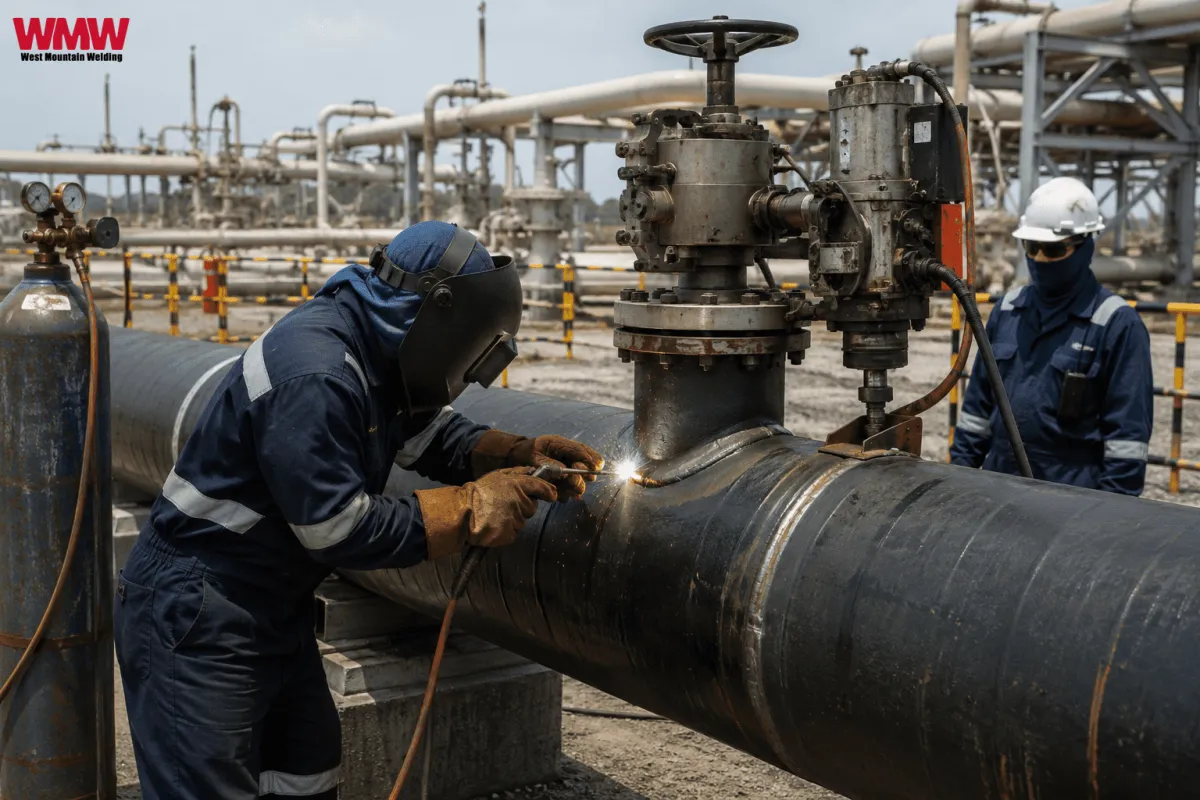
Hot tap welding is a technique used to weld a new fitting onto a live, pressurized pipeline without stopping the flow of product inside it. A specialized fitting, usually a split tee, is welded around the pipe, a valve is attached, and a tapping machine cuts through the pipe wall to create the new connection, all while the line stays in service.
Key Takeaways
No shutdown required. Hot tap welding allows crews to add connections to an operating pipeline, avoiding the lost production and revenue that come with a full outage.
Split tees are the go-to fitting. These two-piece, custom-fabricated fittings wrap around the pipe and are welded in place before any cutting begins.
Heat control is everything. Since the pipe is under pressure while welded, controlling heat input is critical to avoiding burn-through and weld failure.
Certified welders and qualified procedures are non-negotiable. Codes like API STD 1104 and ASME B31.8 govern how these welds must be performed and inspected.
Not every pipeline qualifies. Wall thickness, material condition, and internal contents all factor into whether a hot tap is safe to perform.
Pipelines rarely get the luxury of standing still. Product keeps moving, pressure stays up, and every day a line sits offline costs real money. So if you need to add a branch connection, install a valve, or tie in a fresh segment of pipe, shutting the whole system down is often the last thing anyone wants to do. That's where hot tap welding comes in.
How Does Hot Tap Welding Work?
At a high level, hot tap welding follows a set sequence, and each stage explains why this work calls for specialized crews rather than a general welding contractor.
Step 1: Feasibility and Engineering Review
Before anyone strikes an arc, the pipeline gets evaluated. Wall thickness, operating pressure, material grade, and pipe condition all get checked. Crews also calculate the maximum temperature the pipe wall can reach during welding without weakening past a safe threshold. If the numbers don't work, the tap doesn't happen without design changes.
Step 2: Fitting Selection and Fabrication
Most hot taps use a split tee: a fitting built in two matched halves, engineered to the exact diameter and wall thickness of the host pipe. The split tee wraps completely around the pipeline and reinforces it at the connection point. For smaller branch sizes, a weld-o-let or reinforced flanged fitting may be used instead.
Step 3: Surface Prep and Welding the Fitting
The pipe exterior is cleaned and prepped to the standard needed for a sound weld. The split tee is then positioned, bolted, and welded around the live pipe using a qualified welding procedure. This is the part of the hot tapping welding procedure where experience matters most. The welder is working on a pipe that's still carrying product, so heat input, travel speed, and pass sequence all have to stay tightly controlled to prevent burn-through.
Step 4: Non-Destructive Testing
Once the fitting is welded, the welds get inspected, typically with magnetic particle or ultrasonic testing to confirm there are no defects. This step isn't optional; a flawed weld on a fitting that's about to be drilled into is a serious safety risk.
Step 5: Valve Installation and Pressure Testing
A full-bore gate or ball valve is bolted onto the split tee's flange. Before any cutting begins, the entire assembly gets pressure tested to confirm it's sealed and ready to hold the line's operating pressure.
Step 6: The Hot Tap Cut
With the tapping machine mounted on the valve, the cut happens in one continuous pass. A pilot bit centers the cutter, which bores through the pipe wall and removes a circular section called the coupon. Retention wires typically hold the coupon in place so it doesn't drop into the flowing pipeline.
Step 7: Closing the Valve and Finishing the Connection
Once the coupon is out, the tapping machine retracts, and the valve closes to isolate the new branch. From there, the branch line gets purged, tied in, and put into service, all without the parent pipeline going down.
What Is a Split Tee, and How Does It Fit In?
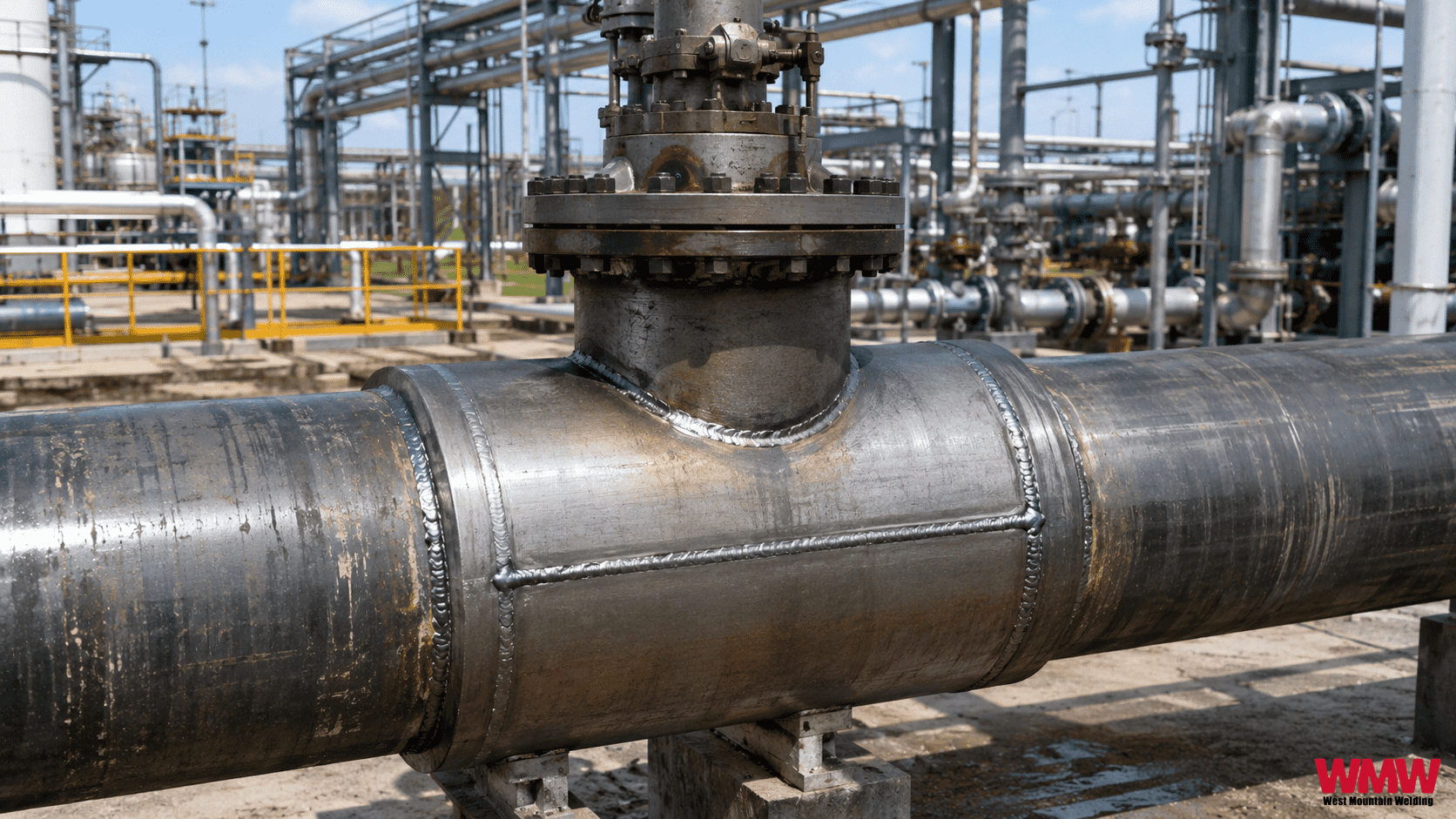
If hot tapping is the method, the split tee is the hardware that enables it. Think of it as a sleeve, custom-built in two halves to match the pipe's exact outer diameter. The two halves are bolted together around the pipe, then welded along the seams where the halves meet (longitudinal welds) and around the pipe circumference (circumferential welds).
This full-encirclement design does two jobs at once: it reinforces the pipe at the point where material is about to be removed, and it provides the flanged outlet where the isolation valve and tapping machine attach. A hot tap split tee welding job has to account for pipe diameter, wall thickness, material grade, and design pressure. A fitting that doesn't match the host pipe precisely will not seal properly, and that's not something you want to discover after the cut has started.
Why Choose Hot Tapping Over a Pipeline Shutdown?
For pipeline operators, the case for hot tap welding usually comes down to cost, continuity, and practicality.
Avoiding downtime. A shutdown means lost throughput, and for large transmission lines, that can mean significant revenue loss for every hour offline.
Maintaining supply. Gas and water utilities can't always afford to interrupt service, especially in winter months or high-demand periods.
Reducing safety exposure. Purging and depressurizing a large pipeline carries its own risks. Keeping the line pressurized and performing a controlled hot tap is sometimes the safer option.
Supporting expansion. New branch lines, added production capacity, or looped systems can be tied in without disrupting the existing network.
When Is Hot Tap Welding Not the Right Fit?
Hot tapping is powerful, but it's not universal. Several conditions typically rule it out or require extra engineering review:
Thin pipe walls. Pipe with a wall thickness below roughly 6mm carries a higher risk of burn-through during welding.
Materials requiring post-weld heat treatment. If the parent pipe material requires PWHT, a standard hot-tap weld procedure may not be adequate.
Internally lined or coated pipe. Cement, refractory, or glass linings complicate both the weld and the cut.
Flammable gas-air mixtures inside the line. These conditions raise the risk profile and usually require added safety controls.
Pipe in poor condition. Corrosion, pitting, or unknown wall loss makes it difficult to guarantee the pipe can handle welding heat safely.
A qualified contractor assesses these factors during the feasibility stage, before any fitting is fabricated.
Why Welder Qualification Matters So Much Here
Welding on a pipe that's still under pressure and in service is a different discipline than shop welding or new construction. The welder manages heat input on one side of a pipe wall while product flows or sits under pressure on the other. Too much heat, and the wall can weaken toward a blowout. Too little penetration, and the weld may not hold under operating pressure.
That's why codes like API STD 1104 and ASME B31.8 exist; they set qualification standards for welders, acceptance criteria for weld defects, and recommended sequences for welding split tees, reinforcing pads, and encirclement sleeves. A crew performing hot tap welding procedure work should be able to show:
Certified welders qualified specifically for in-service welding
A written, engineered welding procedure specification (WPS) for the fitting and pipe combination
Material test reports (MTRs) confirming the fitting and pipe are metallurgically compatible
A documented NDT plan for inspecting the completed welds
At West Mountain Welding, this is the standard we hold every hot tap and pipeline welding project to, not because a client asks, but because it's what keeps the pipe, the crew, and the surrounding facility safe.
Hot Tap Welding vs. Line Stopping
These two terms get used interchangeably, but they're not the same thing.
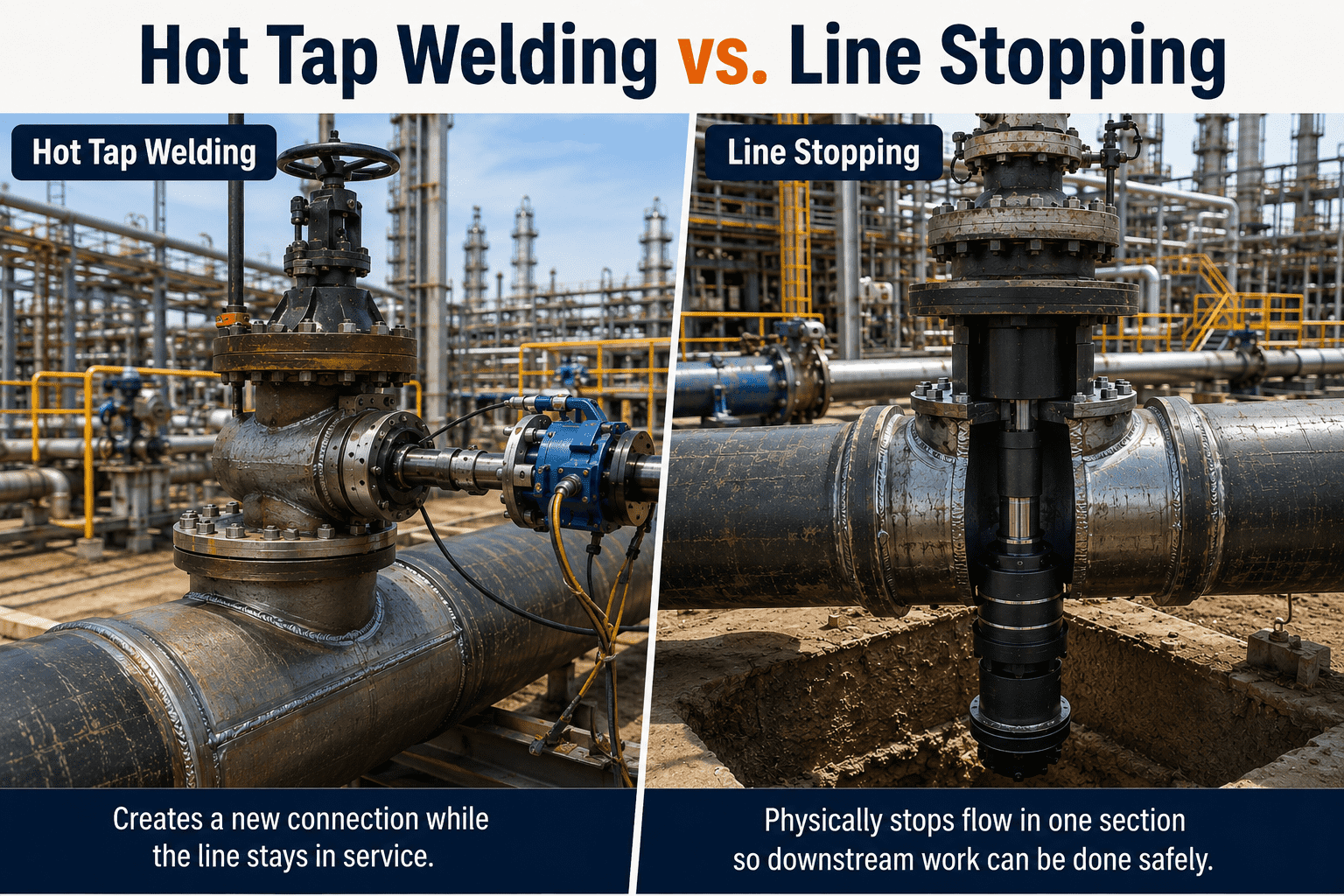
Hot tapping creates a new connection while the line stays in service. Line stopping, sometimes called stoppling, goes a step further: after the tap is made, a plugging head is inserted through the fitting to physically stop flow in one section of pipe, usually so a downstream repair or tie-in can happen dry. Line stops start with a hot tap but add extra equipment and procedure on top.
Working With an Experienced Hot Tap Welding Contractor
Hot tap welding sits at the intersection of pipeline engineering, welding metallurgy, and field safety. The margin for error is thin, and there's no room for guesswork when the pipe stays live throughout the procedure. If you're planning a pipeline tie-in, expansion, or valve addition and want to avoid a costly shutdown, work with a crew that has documented experience in live pipeline welding, current certifications, and a track record of passing NDT inspections on the first try.
West Mountain Welding has performed structural and pipeline welding across Utah's oil, gas, and industrial sectors for years, and hot tap and in-service welding is a core part of that experience. If you have a project that needs a qualified crew and a properly engineered procedure, reach out to discuss your scope of work.
Frequently Asked Questions
1. What is hot tap welding used for?
It's used to add a new branch connection, valve, or tie-in point to a pipeline without shutting down the flow of product inside it. It's common in oil, gas, and water pipeline systems where downtime is costly.
2. How long does a hot tap welding procedure take?
Timing depends on pipe size, fitting complexity, and testing requirements, but a full hot tap from fitting welding through the final cut often takes one to three days, including NDT and pressure testing.
3. Is hot tap welding safe?
Yes, when performed by certified welders following a qualified procedure and applicable codes like API STD 1104. The process is engineered specifically to control heat and pressure risks while the pipe stays in service.
4. What's the difference between hot tapping and a split tee?
Hot tapping is the overall process of cutting into a live pipeline. The split tee is the fitting welded around the pipe that makes the process possible by providing a sealed, reinforced connection point.
5. Can any pipeline be hot tapped?
No. Pipes with very thin walls, poor material condition, certain internal linings, or materials requiring post-weld heat treatment usually can't be safely hot tapped without additional engineering review.